Rescued Lives Part 2 – French Genealogy

Way back, months and months ago, before the wind and the rain and the Christmas, I blogged about some postcards and photos that I purchased in France …

Every so often I declare to myself that I’m going to research the families involved – more so the branch that came from the Deux-Sèvres départment, mostly because it is within this area that my parents live.

A view of Niort from the Sevre Niortaise river, Deux-Sevres, Poitou-Charentes region, France, May 2008 (via dynamosquito on Flickr)

A view of Niort from the Sevre Niortaise river, Deux-Sevres, Poitou-Charentes region, France, May 2008 (via dynamosquito on Flickr)

A few years ago I was in a supermarket looking at the magazines (I don’t mean Paris Match or Maison et Jardin) to get a view of the genealogical representation. I found a couple (I think the most I’ve found is 4 in one particularly large hypermarché) and upon leading through I found an article about the digitisation of French records in their local archives. (As an aside, one thing I’ve noticed about the French is that they may not be first out of the block with an idea, but when the grasp the nettle its with both hands and its done with gusto.) I noticed, with pleasure, that the archives for my parents’ départment was one of the top-rated for online digital access.

LogoSite

The Archives départementales des Deux-Sèvres, located in the wonderful old town of Niort, has over 15,500 documents  in its collection, with its online catalogue broken into 4 areas:

  • Parish & Civil Registers (up to 1932 in places)
  • Napoleonic Cadastre (maps made of every commune between 1808 and 1846)
  • Census Returns (from 1836 until 1901 – although there are some earlier and a few communes up to 1911)
  • Military Matriculation Registers (from 1867 to 1921)
Napoleonic cadastral map 1833. Archives départementales des Deux-Sèvres

Napoleonic cadastral map 1833. Archives départementales des Deux-Sèvres

I have yet to attend the archives in person myself (I’m going to France for a fortnight in June, so who knows?), but I have to say that the online interfaces are pretty simple to use once you know what you’re looking for. There is also a lack of transcribed records so you’re often scrolling through page after page of civil records or census information before you get a hit on what you want.

Before you say it – yes, I’m very much aware of how lucky genealogists nowadays are with the sheer wealth of digitised data that comes complete with indices and search-by-name facilities – but occasionally you rub up against something that isn’t quite what you expect, or what you’ve become used to. Its a bit like stubbing your toe. And makes you appreciate what you do have all the more.

Luckily, from Louise’s identity card I knew her date and place of birth: 28 January 1912, St-Martin-de-Sanzay, Deux-Sèvres. Using the online records, I was able to find a copy of her birth entry.

Birth of Louise Baranger. Archives départementales des Deux-Sèvres

Birth of Louise Baranger. Archives départementales des Deux-Sèvres

The details given are fantastic. Not only the usual information such as name, date and place of birth, and the name of the parents, but also the time of her birth (6pm), the age of her parents (25 and 17 respectively) and even an update with details of her marriage: 14 April 1936 in Chateaubriant to (what looks like) ‘Revie Jules Cyrile’ Gendron.

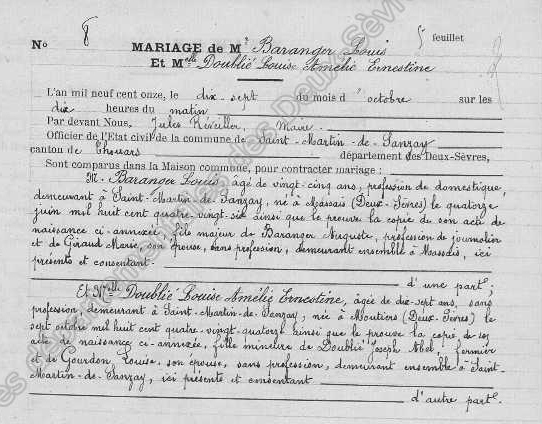
Given the somewhat tender age of the mother (Louise Amelie Ernestine Doublié), she and Louis couldn’t have been married much before this date. Indeed, it didn’t take long when searching backward, to find it on 17 October 1911, in St. Martin.
_ad79_etatcivil_4e28417_frad0794e284170060jpg_780_495.6_1498_0_1978_1255_0_0_0_0.jpg_mark

Some great extra details here: occupations, ages, birth dates and places of both parties, with names – including maiden names of the mother! – of all the parents.

Given the fact that Amelie was around 6 months pregnant at the time of the marriage (and 7 years younger than the groom), it would be easy to assume that it was a marriage that was forced upon her after the nasty man had his wicked way with her. However, reading the correspondence between them, both from before the marriage and afterwards, it is clear that the pair were very much in love.

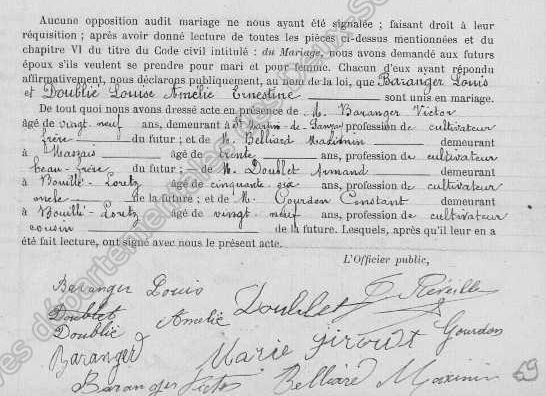
At the bottom of the page is a list of the witnesses, and a collection of signatures:
_ad79_etatcivil_4e28417_frad0794e284170060jpg_780_454.8_1530_1369_1946_1135_0_0_0_0.jpg_mark

Victor Baranger is mentioned in the postcards regularly, so its good to get it confirmed that he was Louis’ brother! It also seems that there is a connection between the Doublié and Doublet families – so much so that initially Amelie signs her name as Doublet and then crosses it out.

The birth entry for Amelie confirms everything, including a stamped addition of her marriage. There is also a handwritten note of the date and location of her death, in 1972.

Amelie and her parents are in Moutiers-sous-Argenton, the village of her birth, in the 1896 census:

Recensements de population MOUTIERS-SOUS-ARGENTON 1896

Recensements de population
MOUTIERS-SOUS-ARGENTON 1896

The family are still there in 1901, and Amelie has been joined by a younger brother, Joseph, born in 1897. The 1906 shows a 3rd child, Josephine, born in 1903. Unfortunately the censuses available online end there, but by 1911 the family are living in St. Martin.

After several hours scrolling through birth, marriage and death records along with umpteen different census returns, I have managed to compile a rough tree for Louise Gendron, nee Baranger. I’ll fill it in over the next few days with the people mentioned in the postcard collection, but in the mean time here it is:
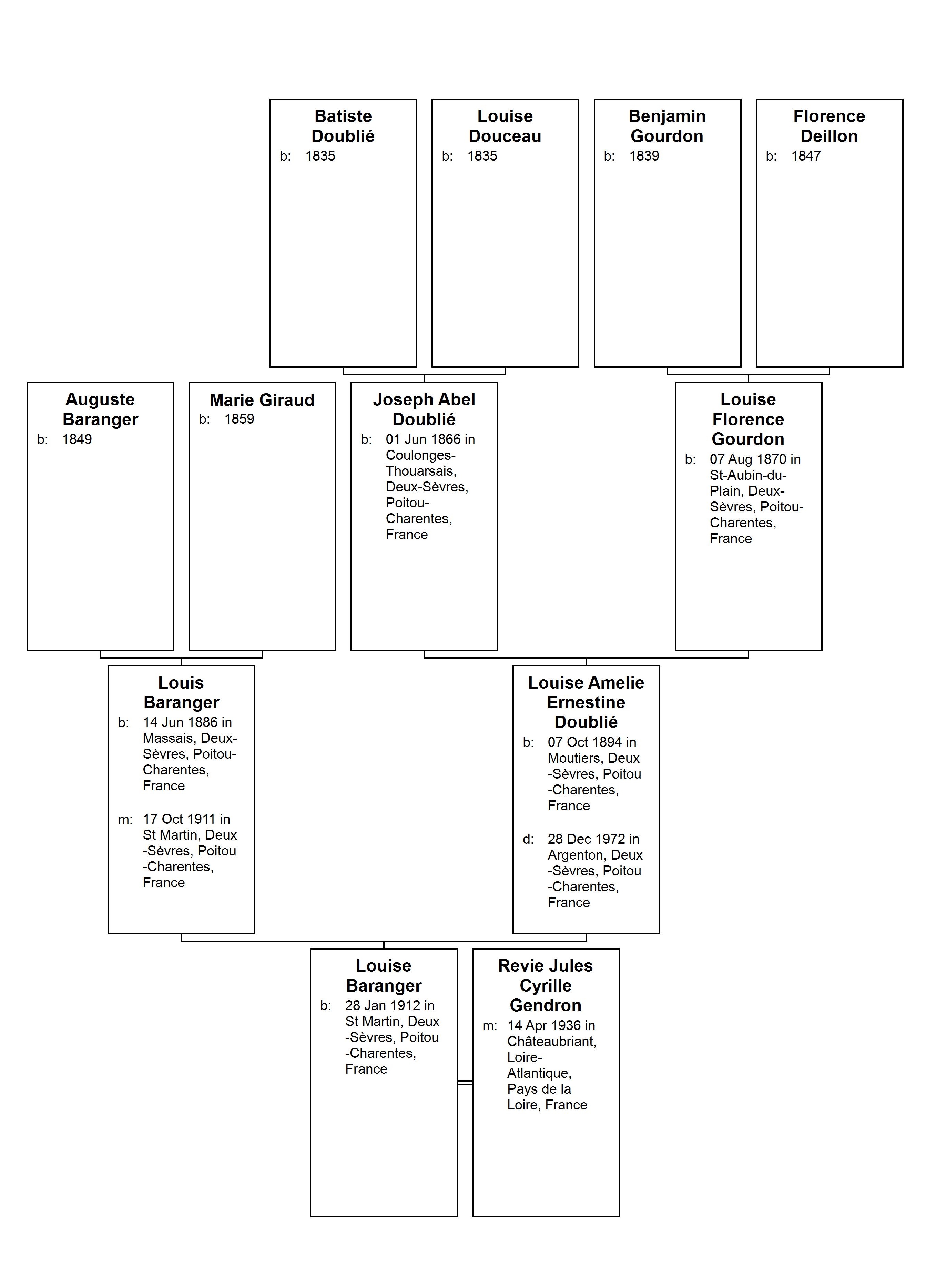
Vertical Pedigree Chart for Louise Baranger

Witchy Witchness

Its always good when you have an ancestor – or at least family – involved in one of history’s Great Events. Not that you wish them harm, but it increases the likelihood of there being records regarding their life – or at the minimum proves that they were there. Its one of the reasons military-minded ancestors are such a boon: not only do you get a shot at some personal info (height, weight, hair/eye colour, etc) but also – if you’re lucky – you get a sense of the kind of person they were.

During my investigations into my American families, its only my paternal side that has given me any long roots in America (not that the maternal side has none – I just haven’t been able to find it yet!), and there is a frisson when you get back as far as the 1600s and can count the ‘Founding Fathers’ of certain townships in your ancestry. But leading back to New Hampshire in the late 17th century there is also another event that looms at the back of your mind: the Salem witch trials.

Salem-Witch-Trials

“The Witch, No. 1”, c.1892 lithograph by Joseph E. Baker.

Continue reading

Jacob Calvin Adams

The Adams’ were first introduced via my grandfather, Ellis Howard Adams. In tracing him I learnt (rather quickly) that his parents were Jacob Calvin Adams and Dolly Clara Faulkner, and Ellis was the ninth of the 10 children born to Jacob and Dolly.

Descendant Chart for Jacob Calvin Adams

I was able to trace Jake back to the 1900 US census with no difficulty, but not before that. It also appeared that Jake had been married once before marrying my great-grandmother Dolly, and had a son called Roy.

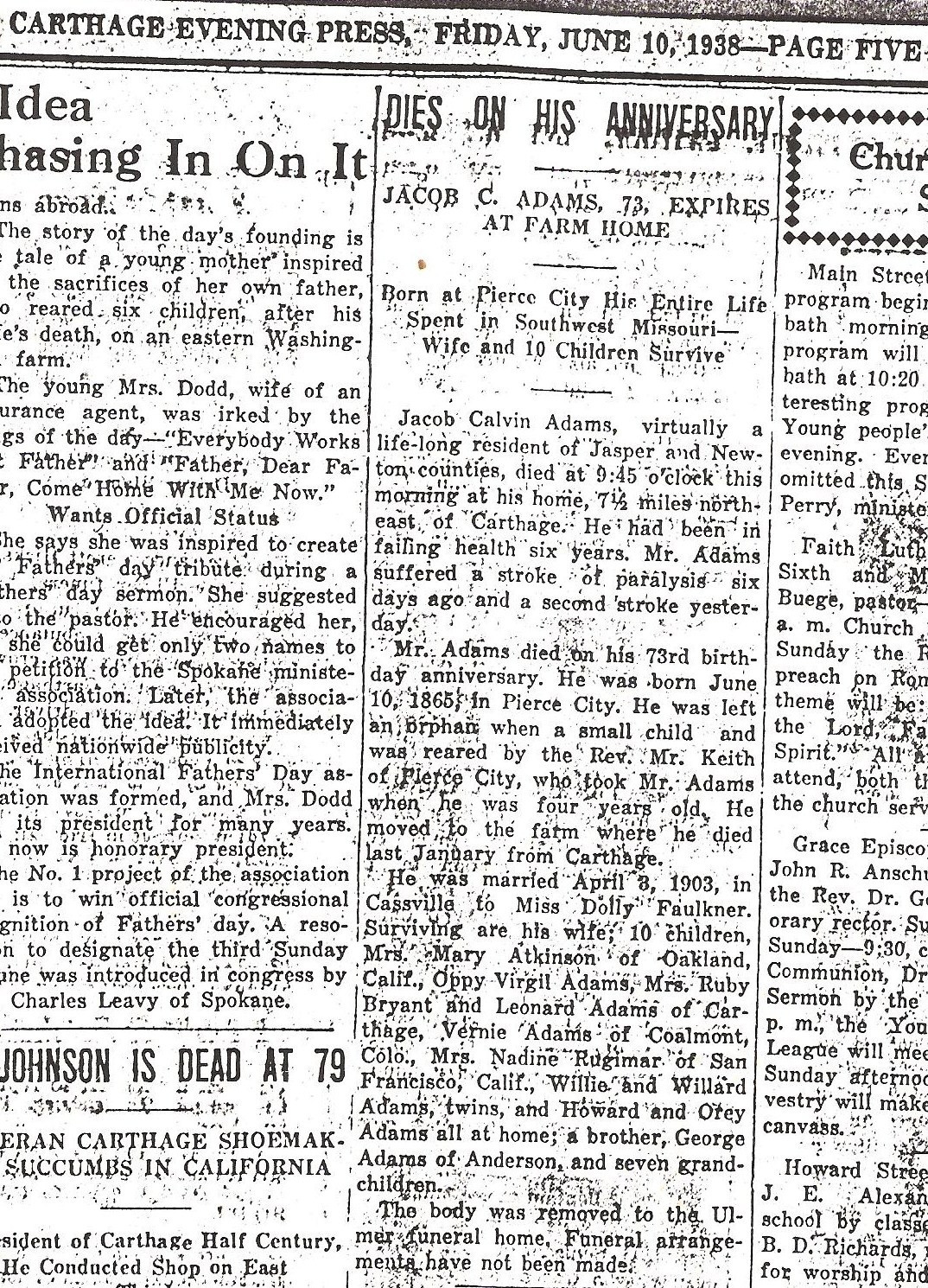
Jake is also unusual in that, thanks to online trees being published, one of the first records I had of him was that of his obituary and the funeral notice in the local newspapers:

Jacob Adams' Obituary
Jacob Adams Funeral Notice

The obituary was key in picking out key details of Jacob’s life. That he died on his 73rd birthday, his exact birth and death dates and locations and names of his children and wife, including the date of their wedding. Genealogical gold! It also mentions a brother, George, and that the boys had been orphaned at a young age and subsequently adopted by the Reverend Mr. Keith c.1869.

However, Reverend Keith, George and Jacob remain elusive in the 1870, 1880 and 1890 US censuses (not so surprising for the 1890 census as what wasn’t destroyed in a fire in 1921 was destroyed by the Librarian of Congress in the 1930s).

I’ve emailed the State Archives to see if they can shed any light on the mysterious Reverend Mr Keith, or the birth records of Jacob and George. I did also email the Pierce City Branch Library but their email address seems to be null and void. This is the second time I’ve had a similar experience when emailing public offices in America.

In 1900 Jacob was living with his first wife in Washington Township, Missouri and gave his occupation as Farm Laborer.

Jake in 1900 US Census

He married Dollie Clara Faulkner on 3 April 1903 in Cassville, Barry, Missouri. Their first child, Mary, was born exactly 9 months later.

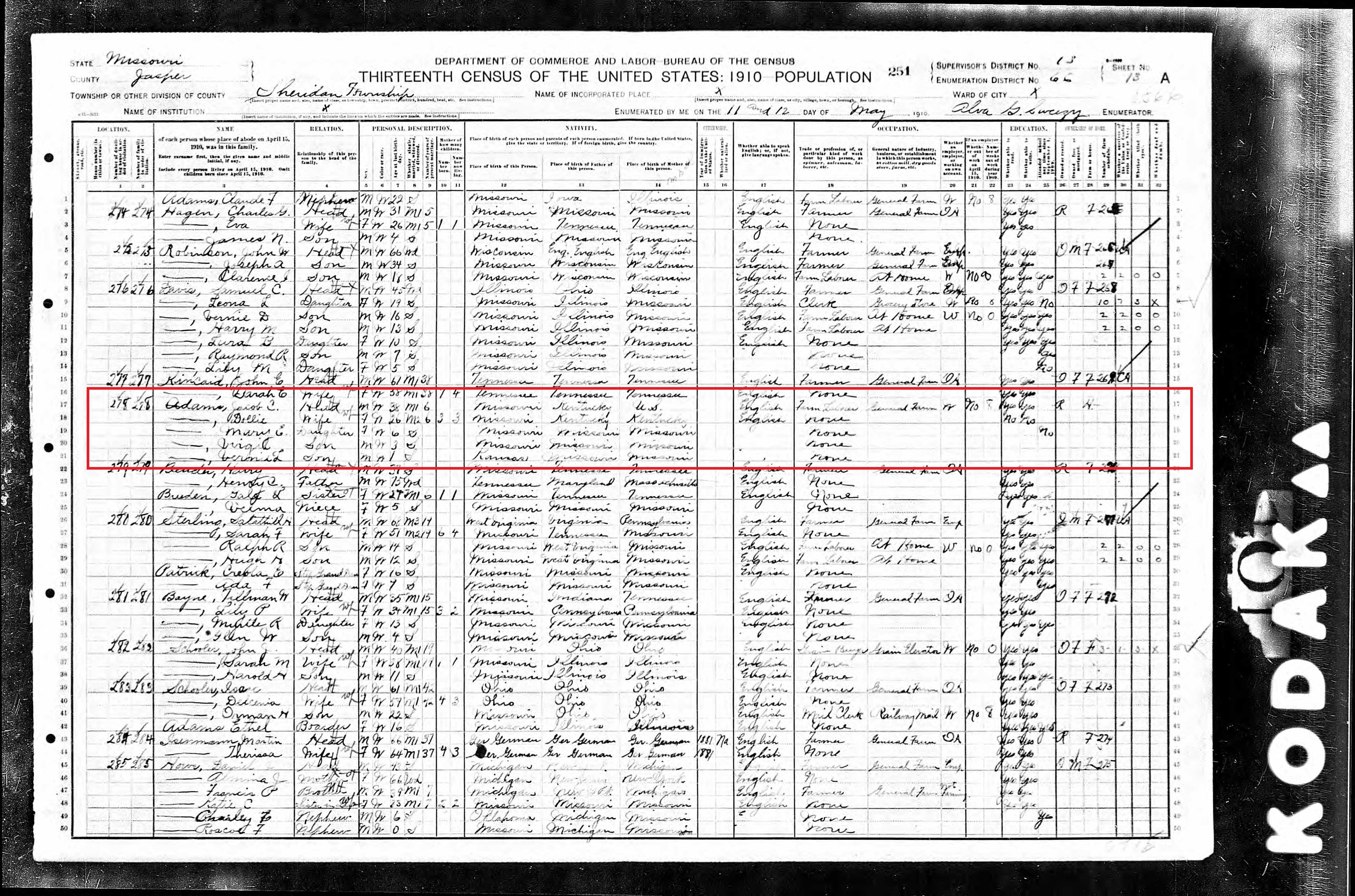
By 1910 the family is living in Sheridan Township, Jasper, Missouri. Mary has been joined by siblings Virgil and Vernon.

Jacob in 1910 US Census

In 1920 the family had travelled almost 250 miles south to Quapaw, Ottawa, Oklahoma, where Jacob was employed at the water works. However, most of the later children (including my grandfather, Ellis) were born in Neosho, Newton, Missouri – less than 40 miles to the east.

jake 1920
Adams family in 1920 US Census

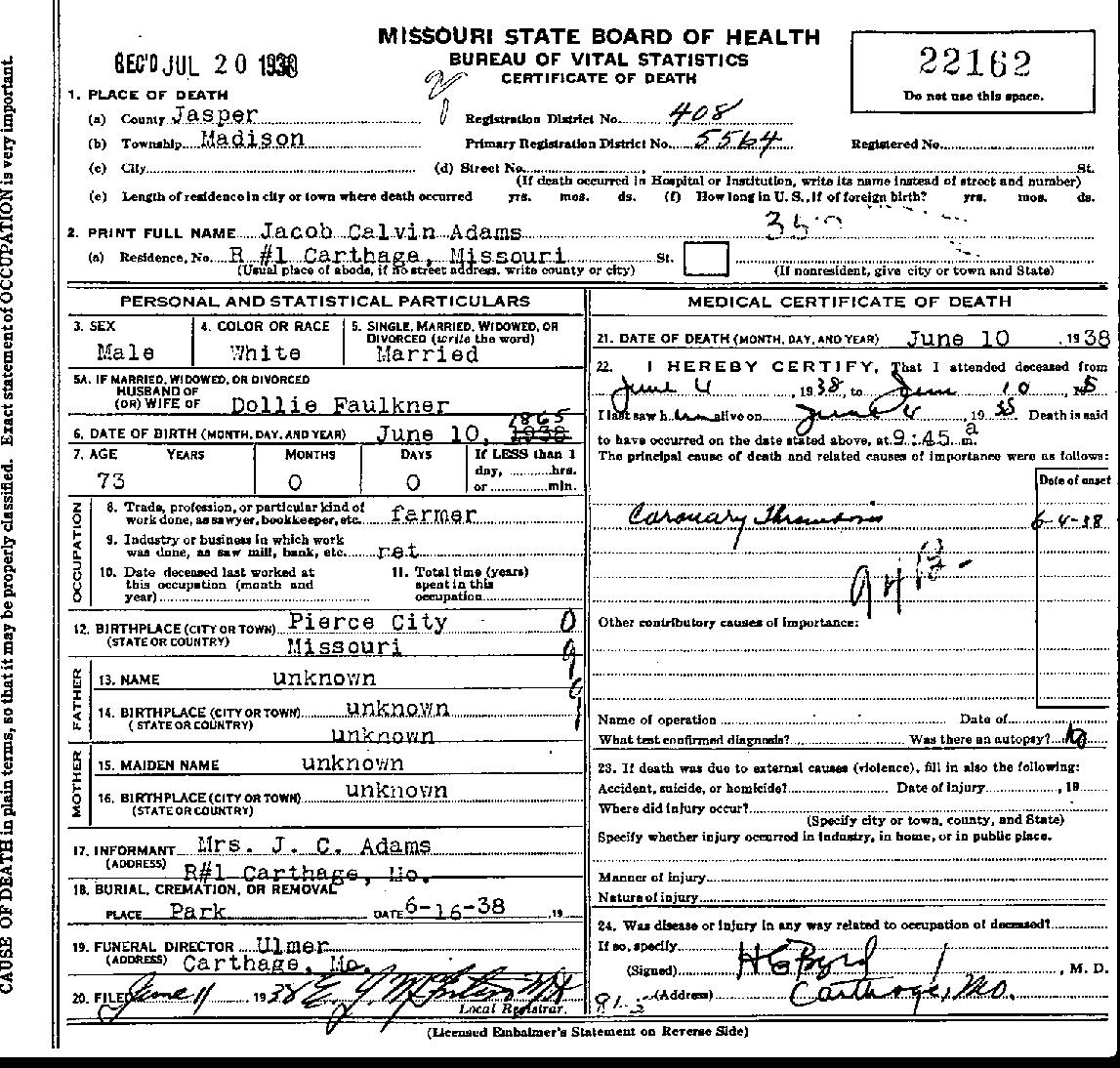
Jacob died – as we have seen already – on his 73rd birthday in 1938.

His death certificate lists cause of death as coronary thrombosis – aka myocardial infarction or heart attack. The informant was his wife Dollie, but no details are listed for his parents. Presumably whatever little information was known by the orphaned Jacob was not passed on to his wife.

Jacob Adams Death Certificate-page-001

Should I receive a response from the Missouri State Archives then his story will continue. However, for now at least, it seems as if my Adams line will remain a mystery.

Grampy Eddie Taplin

It struck me a moment ago that I hadn’t ever got around to publishing a post regarding my fourth grandfather – Eddie Taplin. I’ve written about Ellis, Otto and Bob, but not Eddie.

As mentioned in my first post regarding grandfathers, I have no memory of Eddie, yet I was named (in part) after him. So what do I know about him?

Continue reading

Vintage Postcards – 9: Happy New Year!

Now, the original plan was to post one of the cards every other day (on the odd days) up until New Year’s Eve itself with the final hurrah.

29 December 1921 - To sister, brother and niece from Gabrielle Doublie

29 December 1921 – To sister, brother and niece from Gabrielle Doublie

However, I forgot to queue up some posts and got a bit busy and … then there was Christmas and one thing and another … And here we are on New Year’s Eve Eve with the final instalment – running from 1919 to 1922.

In the spirit of Lousie’s family:

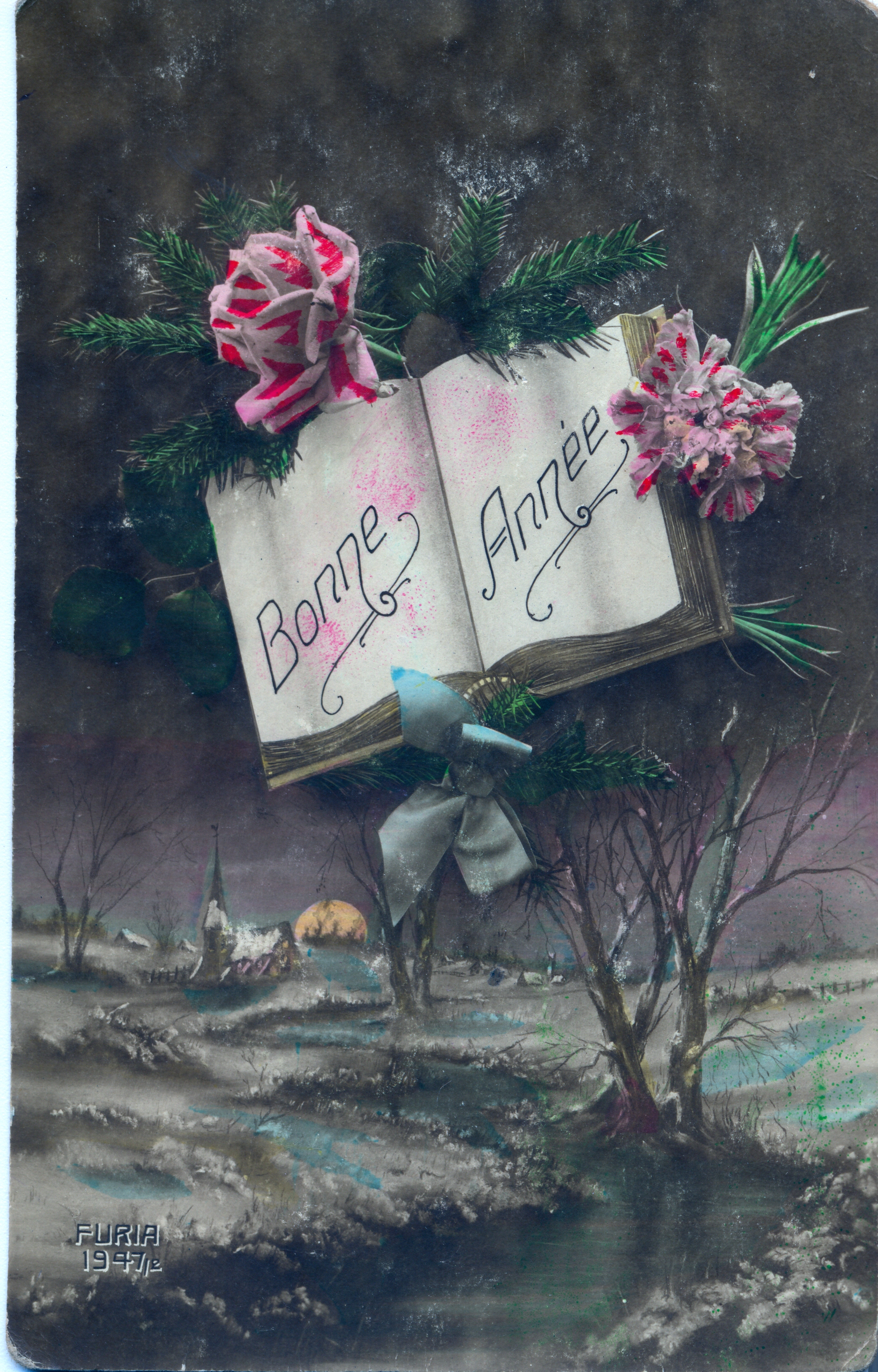
J’offrir mes meilleurs voeux de bonne et heureuse année pour l’an 2014!


Some jolly festive children …


A fine pair of French lovelies …


That is one sassy fur coat at Christmas …

Vintage Postcards – 8

Fast forward several months (okay, a year) and we reach December 1918, and this card sent to Louis by his wife, Amelie. As mentioned previously, Louis was a soldier and by this time World War One had only been over for little more than a month.

I suppose this is the most overtly romantic of the cards – or at least one that lets us peek into the relationship between these two.

Je souhaite de tout coeur que soit la dernière année que tu passe loing de nous … Nous sommes tous en parfaite sante et je desire que tu soit ainsi. 

(I sincerely hope that is the last year you pass away from us … We are all in perfect health and I desire that you be so also.)

29 Dec 1918

Vintage Postcards – 7

Fast-forward a year and we reach le 28 décembre 1918, and another winter scene.

This was sent from Joséphine Doublié to her godfather and contains the usual best wishes for the oncoming year.


28 Dec 1918

Vintage Postcards – 6

Because a child with a goat just isn’t enough … here’s the old classic Girl With Dwarf Elephant.

Sent by Louise herself to her mother and dated 1 January 1918, it still has the hand-ruled pencil lines on it to mark the bottom of the lines and also the top of the lower case letters!

The card also sends happy new year wishes to Angele Denis and “petite Andree et chez elle“, as well as “la famille Biardeau“.

She signs off with ‘a thousand kisses’:

“Reçois chère maman les mille baisers de ta fille.”


1 Jan 1918


Vintage Postcards – 5

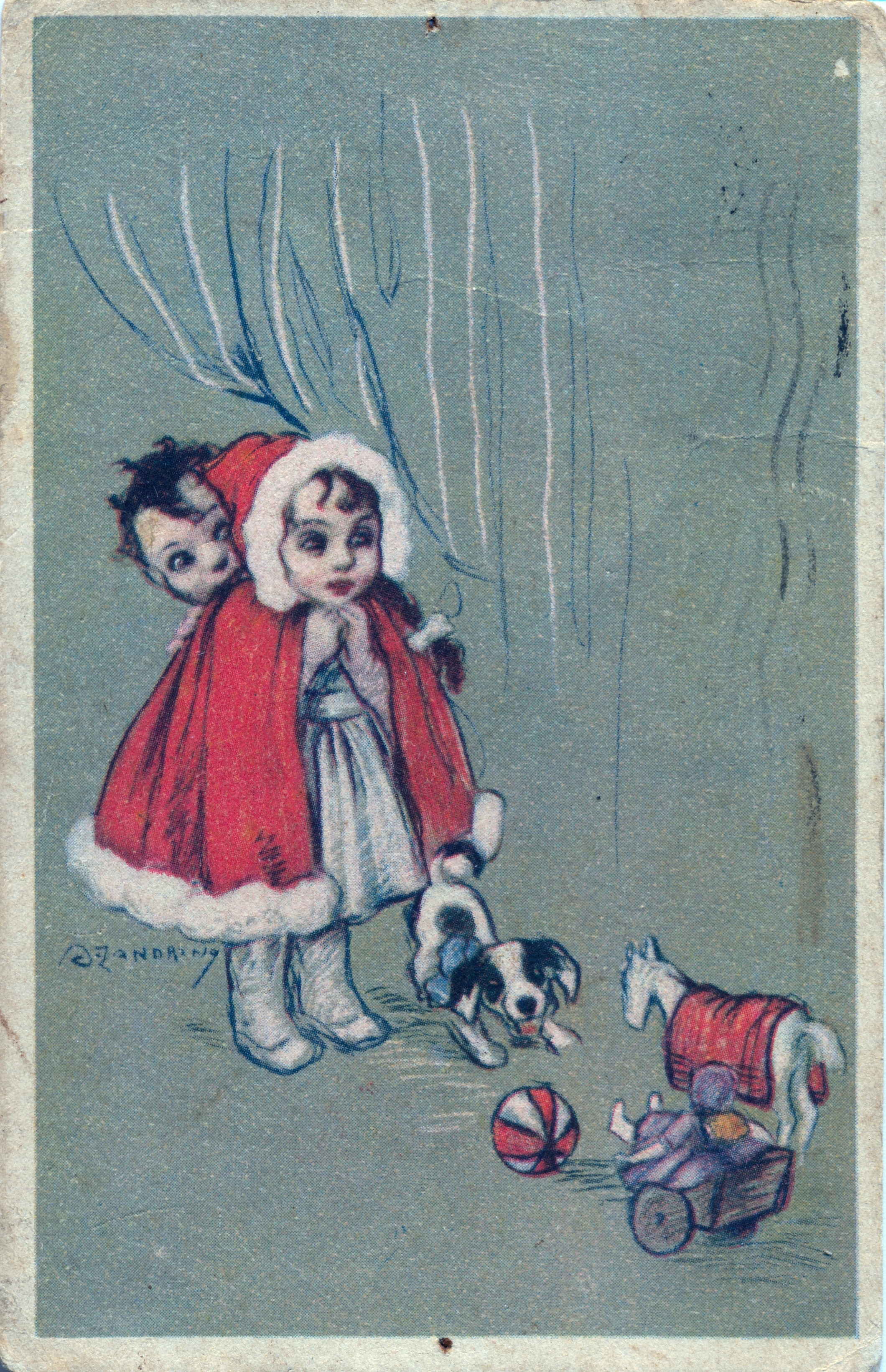
This little card is probably my favourite of the whole bunch, and is much more Christmas-card-like than the French New Year cards, with a wide-eyed ‘Red Riding Hood’ looking at a groupof three toys – perhaps one for her, one for her male companion and one for her puppy …

Uncle Pierre sent this to Charlie on 26 December 1917. At this time Pierre was in Genoa, Italy, and Charles Bory was living in Lausanne. I like to think that Charlie found this card as charming as I do as there are two pin holes at the top and bottom, indicating that it was pinned to a wall or board at some point of its life.

Red Riding Hood

Red Riding Hood

Vintage Postcards – 4

The next card was sent by Adrienne Doublié on 31 December 1913 and is addressed “Cher cousin et cousines“.

The subject of the card is quite romantic, with a dashing (albeit slightly … fey) young man and his charming young woman presented with a bouquet of flowers, underneath a heart-shaped woodland scene.

The message written on the back (presumably by the same pen and ink that was spilt on the front!) is exactly as you’d expect:

Je vous envoie cette carte pour souhaiter la bonne année à toute la famille.

(I’m sending you this card to wish a happy new year to all the family.)

… but the last sentence made me smile. All the other cards simply extend good wishes to the recipient … but Adrienne has this to add:

J’espere que vous m’en souhaiter autant.

(I hope you all wish me as much.)


31 Dec 1913

31 Dec 1913