family history

Rescued Lives Part 2 – French Genealogy

Way back, months and months ago, before the wind and the rain and the Christmas, I blogged about some postcards and photos that I purchased in France …

Every so often I declare to myself that I’m going to research the families involved – more so the branch that came from the Deux-Sèvres départment, mostly because it is within this area that my parents live.

A view of Niort from the Sevre Niortaise river, Deux-Sevres, Poitou-Charentes region, France, May 2008 (via dynamosquito on Flickr)

A view of Niort from the Sevre Niortaise river, Deux-Sevres, Poitou-Charentes region, France, May 2008 (via dynamosquito on Flickr)

A few years ago I was in a supermarket looking at the magazines (I don’t mean Paris Match or Maison et Jardin) to get a view of the genealogical representation. I found a couple (I think the most I’ve found is 4 in one particularly large hypermarché) and upon leading through I found an article about the digitisation of French records in their local archives. (As an aside, one thing I’ve noticed about the French is that they may not be first out of the block with an idea, but when the grasp the nettle its with both hands and its done with gusto.) I noticed, with pleasure, that the archives for my parents’ départment was one of the top-rated for online digital access.

LogoSite

The Archives départementales des Deux-Sèvres, located in the wonderful old town of Niort, has over 15,500 documents  in its collection, with its online catalogue broken into 4 areas:

  • Parish & Civil Registers (up to 1932 in places)
  • Napoleonic Cadastre (maps made of every commune between 1808 and 1846)
  • Census Returns (from 1836 until 1901 – although there are some earlier and a few communes up to 1911)
  • Military Matriculation Registers (from 1867 to 1921)
Napoleonic cadastral map 1833. Archives départementales des Deux-Sèvres

Napoleonic cadastral map 1833. Archives départementales des Deux-Sèvres

I have yet to attend the archives in person myself (I’m going to France for a fortnight in June, so who knows?), but I have to say that the online interfaces are pretty simple to use once you know what you’re looking for. There is also a lack of transcribed records so you’re often scrolling through page after page of civil records or census information before you get a hit on what you want.

Before you say it – yes, I’m very much aware of how lucky genealogists nowadays are with the sheer wealth of digitised data that comes complete with indices and search-by-name facilities – but occasionally you rub up against something that isn’t quite what you expect, or what you’ve become used to. Its a bit like stubbing your toe. And makes you appreciate what you do have all the more.

Luckily, from Louise’s identity card I knew her date and place of birth: 28 January 1912, St-Martin-de-Sanzay, Deux-Sèvres. Using the online records, I was able to find a copy of her birth entry.

Birth of Louise Baranger. Archives départementales des Deux-Sèvres

Birth of Louise Baranger. Archives départementales des Deux-Sèvres

The details given are fantastic. Not only the usual information such as name, date and place of birth, and the name of the parents, but also the time of her birth (6pm), the age of her parents (25 and 17 respectively) and even an update with details of her marriage: 14 April 1936 in Chateaubriant to (what looks like) ‘Revie Jules Cyrile’ Gendron.

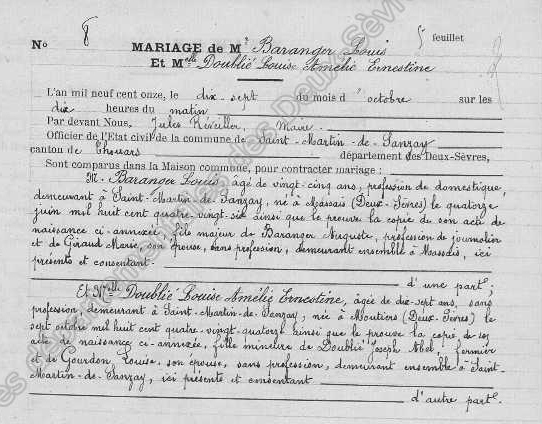
Given the somewhat tender age of the mother (Louise Amelie Ernestine Doublié), she and Louis couldn’t have been married much before this date. Indeed, it didn’t take long when searching backward, to find it on 17 October 1911, in St. Martin.

_ad79_etatcivil_4e28417_frad0794e284170060jpg_780_495.6_1498_0_1978_1255_0_0_0_0.jpg_mark

Some great extra details here: occupations, ages, birth dates and places of both parties, with names – including maiden names of the mother! – of all the parents.

Given the fact that Amelie was around 6 months pregnant at the time of the marriage (and 7 years younger than the groom), it would be easy to assume that it was a marriage that was forced upon her after the nasty man had his wicked way with her. However, reading the correspondence between them, both from before the marriage and afterwards, it is clear that the pair were very much in love.

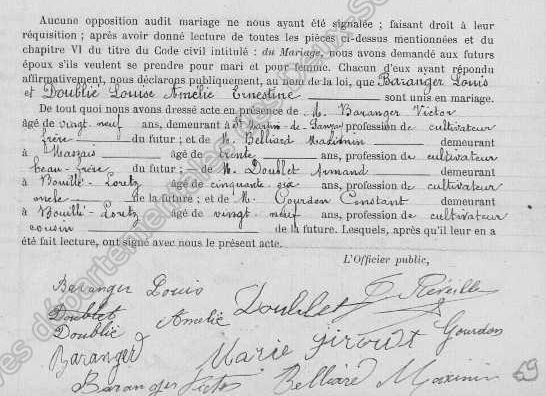
At the bottom of the page is a list of the witnesses, and a collection of signatures:

_ad79_etatcivil_4e28417_frad0794e284170060jpg_780_454.8_1530_1369_1946_1135_0_0_0_0.jpg_mark

Victor Baranger is mentioned in the postcards regularly, so its good to get it confirmed that he was Louis’ brother! It also seems that there is a connection between the Doublié and Doublet families – so much so that initially Amelie signs her name as Doublet and then crosses it out.

The birth entry for Amelie confirms everything, including a stamped addition of her marriage. There is also a handwritten note of the date and location of her death, in 1972.

Amelie and her parents are in Moutiers-sous-Argenton, the village of her birth, in the 1896 census:

Recensements de population MOUTIERS-SOUS-ARGENTON 1896

Recensements de population
MOUTIERS-SOUS-ARGENTON 1896

The family are still there in 1901, and Amelie has been joined by a younger brother, Joseph, born in 1897. The 1906 shows a 3rd child, Josephine, born in 1903. Unfortunately the censuses available online end there, but by 1911 the family are living in St. Martin.

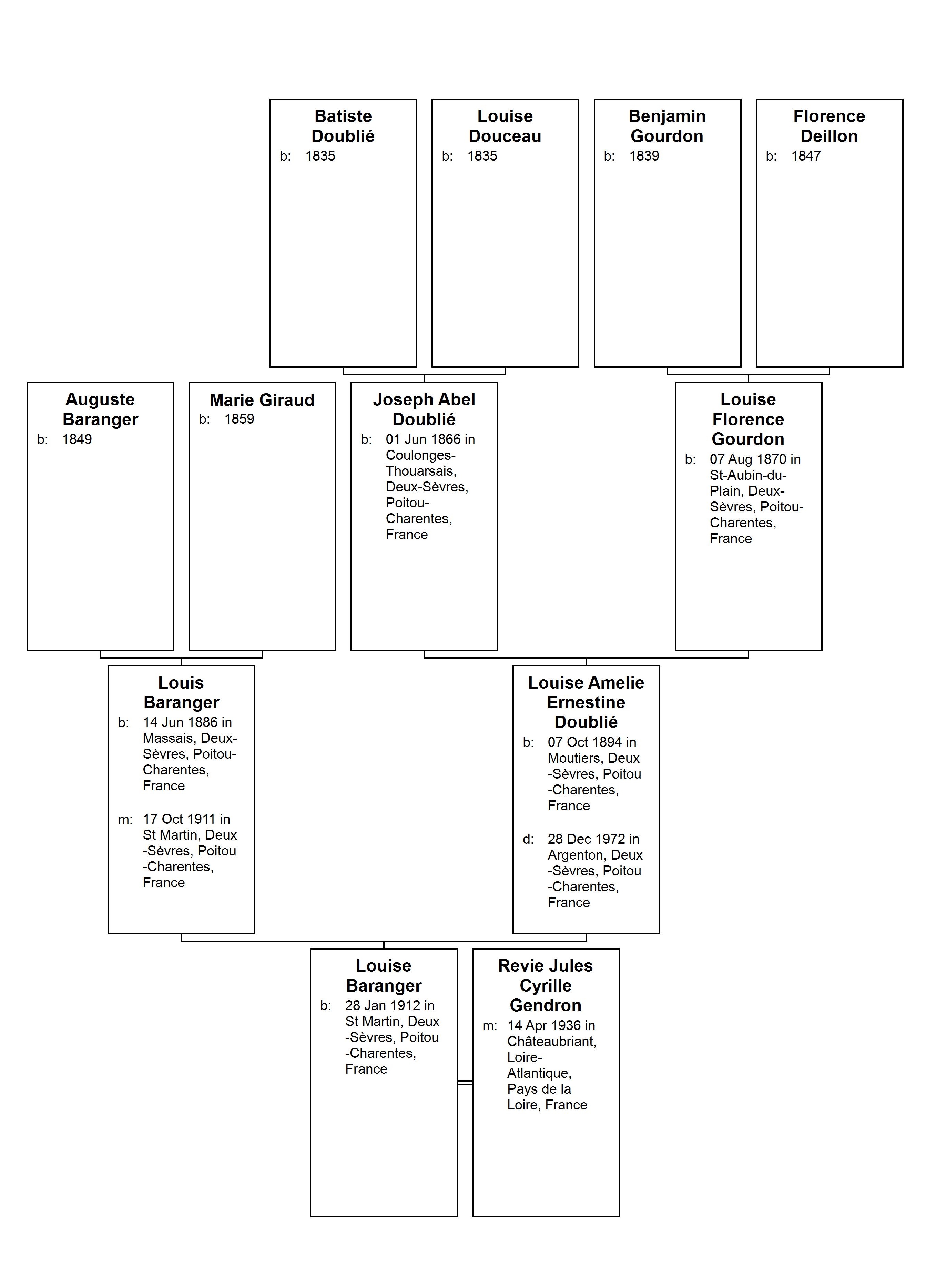
After several hours scrolling through birth, marriage and death records along with umpteen different census returns, I have managed to compile a rough tree for Louise Gendron, nee Baranger. I’ll fill it in over the next few days with the people mentioned in the postcard collection, but in the mean time here it is:

Vertical Pedigree Chart for Louise Baranger

Witchy Witchness

Its always good when you have an ancestor – or at least family – involved in one of history’s Great Events. Not that you wish them harm, but it increases the likelihood of there being records regarding their life – or at the minimum proves that they were there. Its one of the reasons military-minded ancestors are such a boon: not only do you get a shot at some personal info (height, weight, hair/eye colour, etc) but also – if you’re lucky – you get a sense of the kind of person they were.

During my investigations into my American families, its only my paternal side that has given me any long roots in America (not that the maternal side has none – I just haven’t been able to find it yet!), and there is a frisson when you get back as far as the 1600s and can count the ‘Founding Fathers’ of certain townships in your ancestry. But leading back to New Hampshire in the late 17th century there is also another event that looms at the back of your mind: the Salem witch trials.

Salem-Witch-Trials

“The Witch, No. 1”, c.1892 lithograph by Joseph E. Baker.

Continue reading

Jacob Calvin Adams

The Adams’ were first introduced via my grandfather, Ellis Howard Adams. In tracing him I learnt (rather quickly) that his parents were Jacob Calvin Adams and Dolly Clara Faulkner, and Ellis was the ninth of the 10 children born to Jacob and Dolly.

Descendant Chart for Jacob Calvin Adams

I was able to trace Jake back to the 1900 US census with no difficulty, but not before that. It also appeared that Jake had been married once before marrying my great-grandmother Dolly, and had a son called Roy.

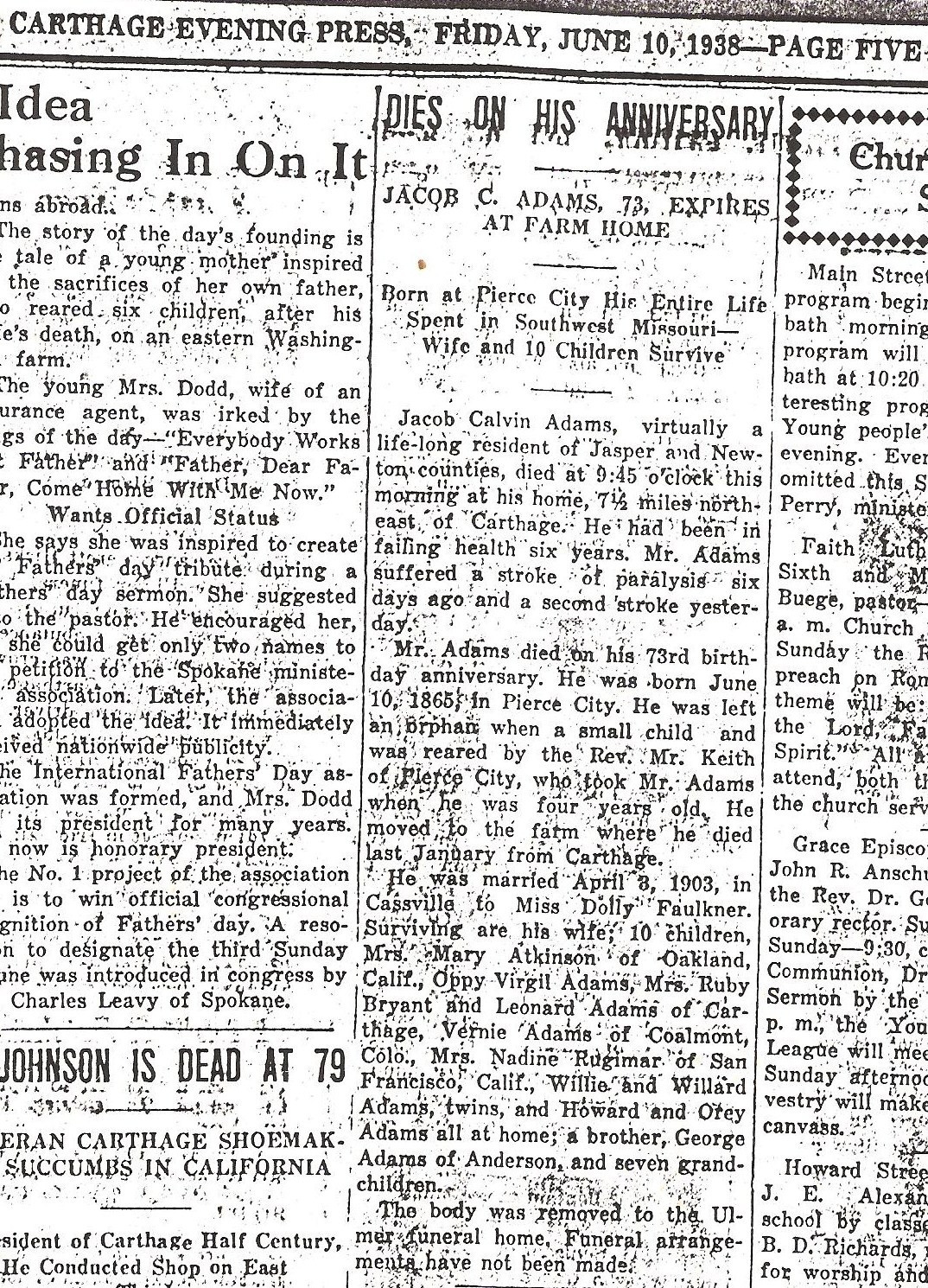
Jake is also unusual in that, thanks to online trees being published, one of the first records I had of him was that of his obituary and the funeral notice in the local newspapers:

Jacob Adams' Obituary
Jacob Adams Funeral Notice

The obituary was key in picking out key details of Jacob’s life. That he died on his 73rd birthday, his exact birth and death dates and locations and names of his children and wife, including the date of their wedding. Genealogical gold! It also mentions a brother, George, and that the boys had been orphaned at a young age and subsequently adopted by the Reverend Mr. Keith c.1869.

However, Reverend Keith, George and Jacob remain elusive in the 1870, 1880 and 1890 US censuses (not so surprising for the 1890 census as what wasn’t destroyed in a fire in 1921 was destroyed by the Librarian of Congress in the 1930s).

I’ve emailed the State Archives to see if they can shed any light on the mysterious Reverend Mr Keith, or the birth records of Jacob and George. I did also email the Pierce City Branch Library but their email address seems to be null and void. This is the second time I’ve had a similar experience when emailing public offices in America.

In 1900 Jacob was living with his first wife in Washington Township, Missouri and gave his occupation as Farm Laborer.

Jake in 1900 US Census

He married Dollie Clara Faulkner on 3 April 1903 in Cassville, Barry, Missouri. Their first child, Mary, was born exactly 9 months later.

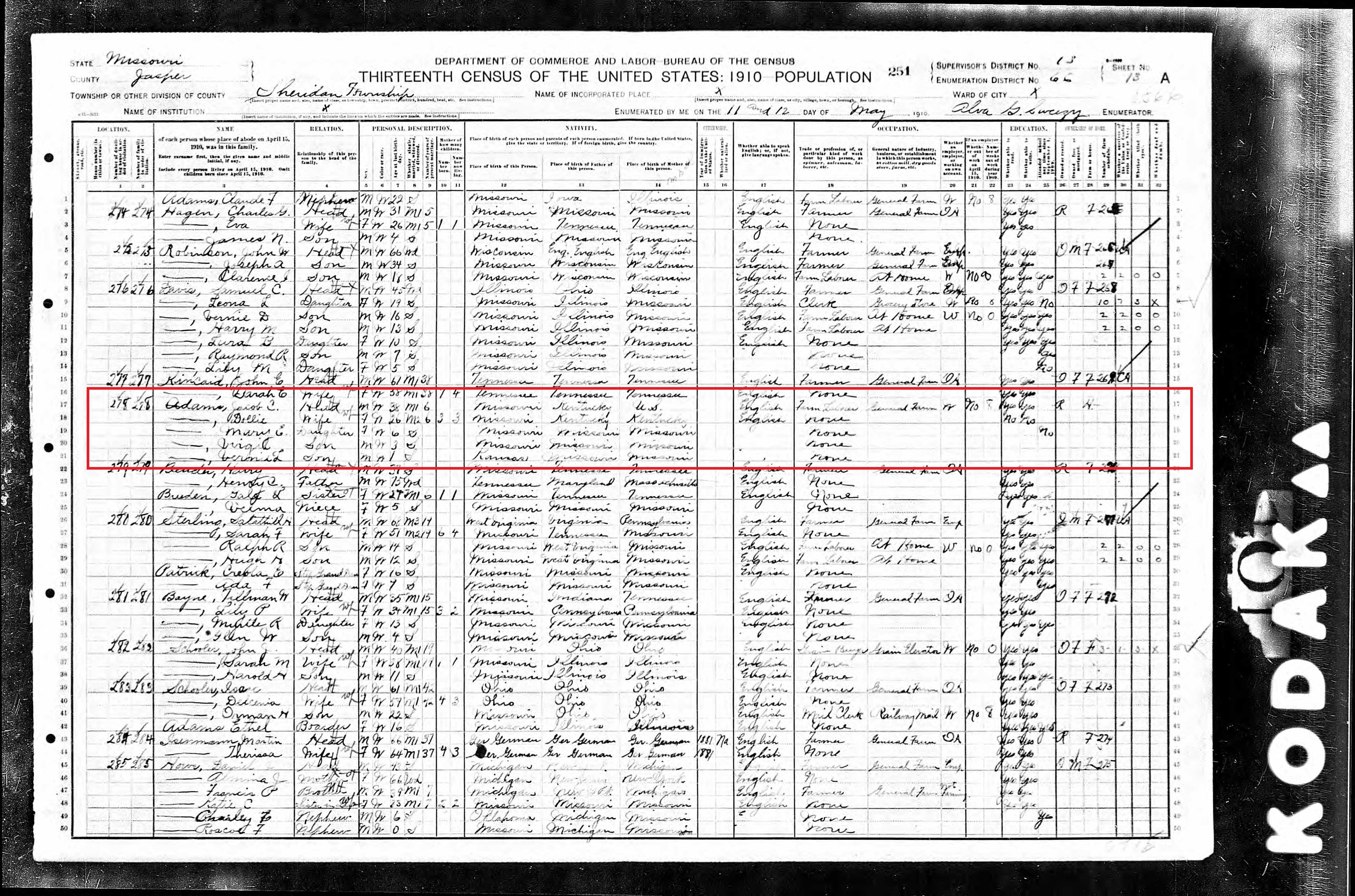
By 1910 the family is living in Sheridan Township, Jasper, Missouri. Mary has been joined by siblings Virgil and Vernon.

Jacob in 1910 US Census

In 1920 the family had travelled almost 250 miles south to Quapaw, Ottawa, Oklahoma, where Jacob was employed at the water works. However, most of the later children (including my grandfather, Ellis) were born in Neosho, Newton, Missouri – less than 40 miles to the east.

jake 1920
Adams family in 1920 US Census

Jacob died – as we have seen already – on his 73rd birthday in 1938.

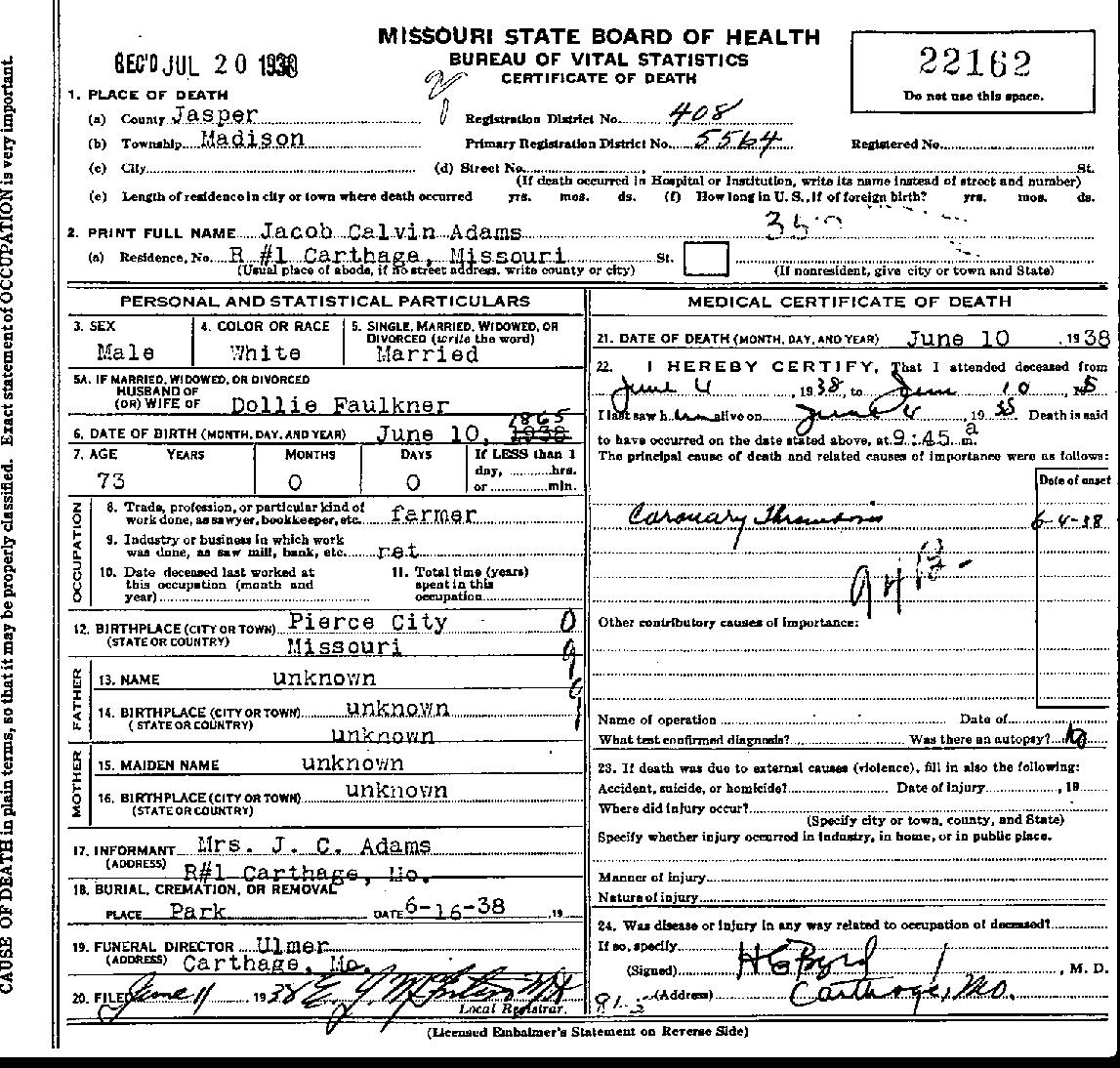
His death certificate lists cause of death as coronary thrombosis – aka myocardial infarction or heart attack. The informant was his wife Dollie, but no details are listed for his parents. Presumably whatever little information was known by the orphaned Jacob was not passed on to his wife.

Jacob Adams Death Certificate-page-001

Should I receive a response from the Missouri State Archives then his story will continue. However, for now at least, it seems as if my Adams line will remain a mystery.

Grampy Eddie Taplin

It struck me a moment ago that I hadn’t ever got around to publishing a post regarding my fourth grandfather – Eddie Taplin. I’ve written about Ellis, Otto and Bob, but not Eddie.

As mentioned in my first post regarding grandfathers, I have no memory of Eddie, yet I was named (in part) after him. So what do I know about him?

Continue reading

Ellis Adams – The Final Chapter (For Now …)

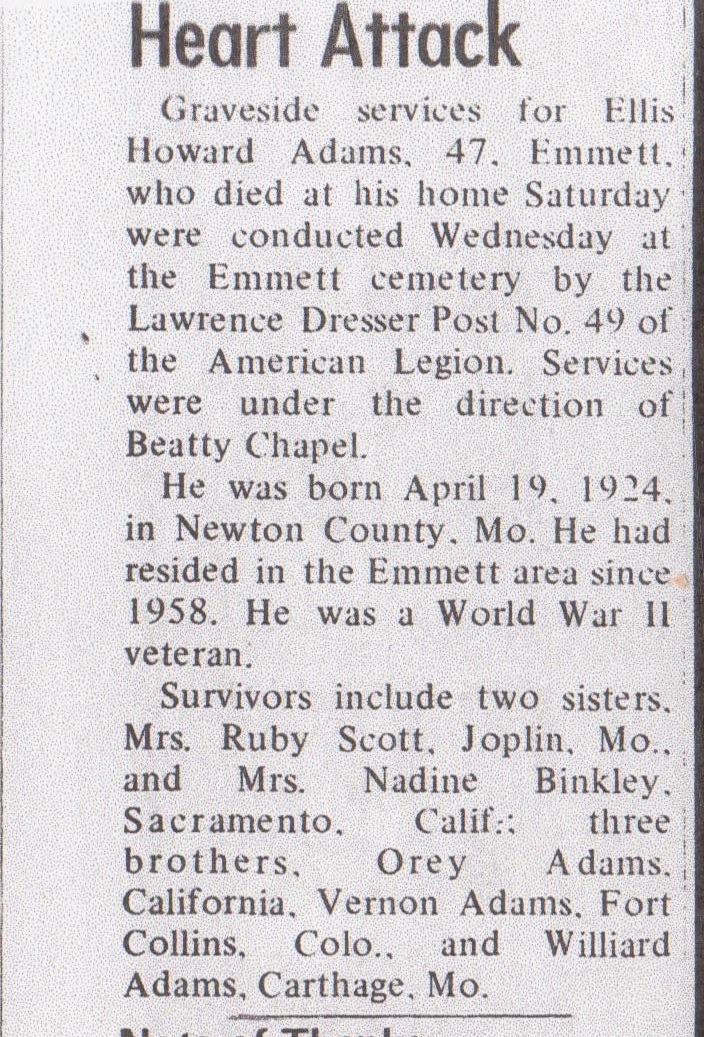
I mentioned a while ago that I’d emailed both the local newspaper in Idaho and the Idaho State Archives requesting any information on Ellis Adams. I had a quick response from the newspaper, who sent the following copy of Ellis’ obituary.

Ellis' Obituary in Emmett Messenger-Index August 1971

Ellis’ Obituary in Emmett Messenger-Index August 1971

It’s sad to think that he died so young of a heart attack – he was only 47. It doesn’t mention another wife or ‘new’ family – but he’d only lived in Emmett for about 13 years, since 1958. Had he remarried following the divorce from Eva? Did he then leave his family and move to Idaho? Where was he between his discharge from the army and him moving there? I don’t know. The 1950 US census will show that he’s a resident in his brother Willard’s house in Carthage, Missouri. Unfortunately I can’t find an Emmett city directory online for the time period in question! Perhaps an inquiry  to the Emmett library may help there …

The Idaho State Archives responded stating that they only had his obituary in their records. I queried if it was the same as the one above, but this wasn’t responded to, but I could have a copy of it emailed to me for a $10 (approx £6) fee. After a few false starts, I had to ring up and attempt to pay over the phone with my credit card. Eventually it all came together (9am in Idaho is 4pm here) and I paid, and the lady sent through a file. A badly fuzzy file. Of the obituary I already had … So that was a bit of a waste of time all round.

The death certificate request was hampered somewhat by me having to prove that I am actually Ellis’ grandson – after a conversation (yes, I rang them up in the USA too) we agreed that my birth certificate and then my mother’s birth certificate would suffice and that I was to fax it over to them. I did want to ask if this was the 1980s but decided against it … Anyway, I have my long-form birth certificate (actually, I have a copy of both long-form and short-form) and ordered a copy of my mother’s (although was a mere 10 minutes late to get it dispatched on Monday!). Following its arrival they were scanned by a friend and then faxed (well, e-faxed) over to Idaho. The same day (Thursday) the certificate was dispatched from Boise, Idaho at around 6pm (Mountain Daylight Time – about 1am here, I think). I think I would probably had it delivered on Saturday if UPS deliver at the weekend. Which they don’t. (Insert rant here about ridiculousness of this.) So today, Monday, I spent every hour eagerly refreshing my UPS tracker to find out when “In Transit” would change to “Delivered”.

It happened, and I came home from work and opened the envelope …

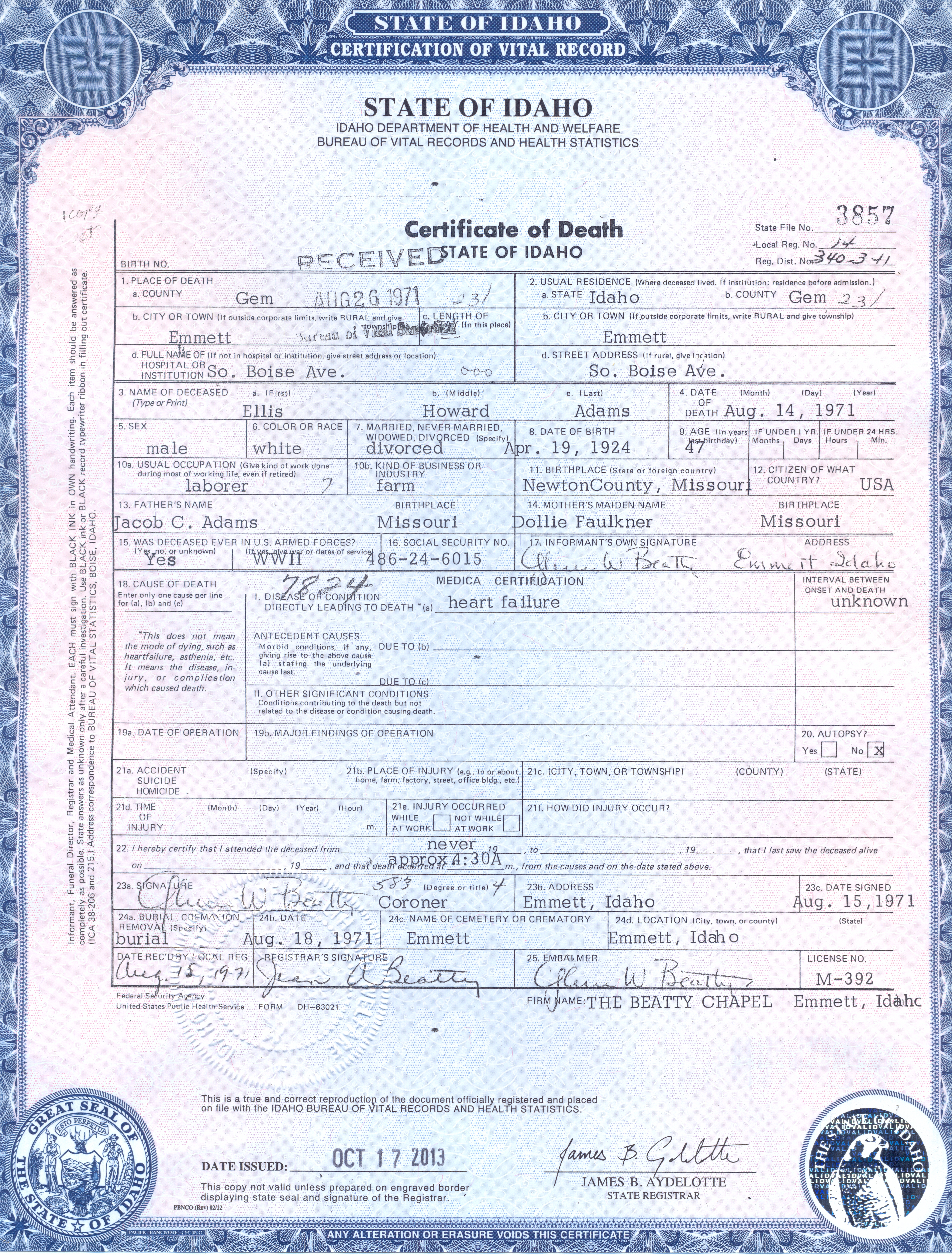
Put it this way, it didn’t tell me anything earth-shattering. He died of “heart failure” at around 4:30am. Listed as divorced, his occupation was farm labourer. He wasn’t under the care of a physician, and the informant was the Emmett Coroner, a Mr. Glenn Beatty. He was buried on 18 August.

Ellis Howard Adams, Death Certificate

Ellis Howard Adams, Death Certificate

The certificate also lists his birth date as 19 April 1924 – no doubt where the information for the grave marker came from – but I’m still happy that it is 10 April – as listed on his Social Security application.

So, all in all I suppose I feel a kind of sadness for Ellis.

Ellis Adams' Gravestone, Emmet, Gem County, Idaho

Ellis Adams’ Gravestone, Emmet, Gem County, Idaho

The “For Now” part of the title was definitely prophetic … see the latest (as of June 2022) update

Ellis Adams – Another Update …

A little more digging (and the message boards at the 78th Division Veteran’s Association) turned up something brilliant …

“The story of the 310th infantry regiment, 78th infantry division in the war against Germany, 1942-1945” was published in Germany in 1946 as a regimental history.

The story of the 310th infantry regiment, 78th infantry division in the war against Germany, 1942-1945

The story of the 310th infantry regiment, 78th
infantry division in the war against Germany,
1942-1945

I downloaded it (via the Bangor Community Digital Commons website) and searched for Ellis to confirm that a) an Ellis Adams was part of 310th, and b) that it was ‘my’ Ellis Adams …
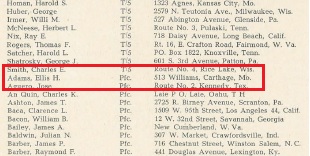
Ellis H Adams, Company A Since October 1944

Ellis H Adams, Company A Since October 1944

There, listed under the members of Company A was ‘Adams, Ellis H.’ The address listed matches that of the census and discharge papers, and his mother was still living there in 1950.

So that tells me that from October 1944 until his discharge in March 1945 he was definitely with 310th – and I now know the areas and battles that he was involved with (more on that in a moment).

I was still left with the question regarding his wounding in battle of July 1944 if 310th didn’t ship out to Europe until October 1944. Then I read two particular paragraphs that might explain this:

Between the months of August 1942 and March 1943, the Division functioned in the capacity of a replacement pool. From everywhere, thousands of enlisted men came to the Division. Some came from various Infantry Replacement Training Centers, some from service units, all were after further training before going overseas. These men usually arrived with some six to thirteen weeks’ training. The 78th Division would try diligently to give them an additional three to six weeks’ training before their number came up for overseas duty. By March 1943, the Division had trained and processed more than 52,000 soldiers for combat duty with other units. … A New Deal for the Division and the 310th Regiment started in March, 1943. Fresh from Reception Centers came strong, young men, mainly in the 18 to 20 year age bracket. They were excellent recruits to add to our experienced cadre.

Then from January to March 1944 came the Tennessee Maneuvers, but:

Then it happened! The regiment pulled into Camp Pickett, Virginia, on April 1st, supposedly all set for combat duty. Two weeks later all the Privates and Privates First Class left the regiment and were on their way to Ports of Embarkation as replacements. Our “team” was broken up. Most of them participated in D-Day landings in France. The drain on the junior officer personnel was equally heavy. Everyone said, “the 78th Division will never go overseas.” It was a bitter pill to swallow.

So this seems to suggest that upon his entry into active service, aged 19, he could well have been with a different regiment (or even with the 310th), sent off to France and sustained his battle wound there and then rejoin (or be transferred to) the 310th in October 1944.

The book does, however, confirm the date that 310th left England for France:

At 0300 November 21, the 310th went by rail to Southampton, and at dawn boarded HMS Llangibby Castle.

HMS Llangibby Castle

HMS Llangibby Castle

Its still a bit of a fly in the ointment of how Ellis could have left Southampton two days before marrying Eva in Devizes … There’s nothing in the book saying that there was a second ship carrying further troops. Again, perhaps in his service record it may have said something about his marriage.
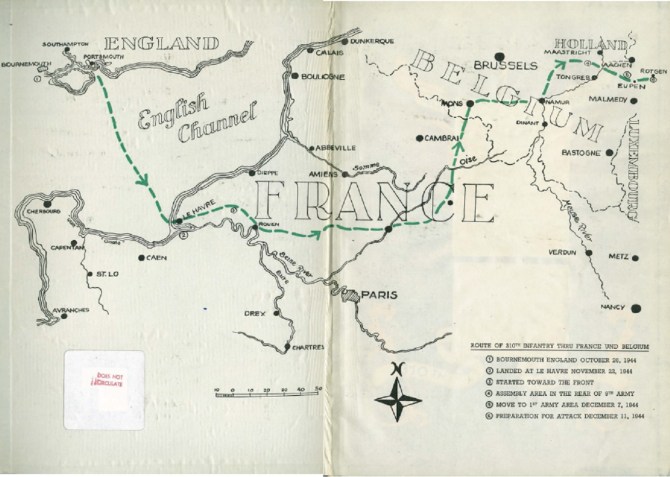
Route of 310th through France and Belgium

Route of 310th through France and Belgium

Although we know that he was in Devizes on 23 November to get married, the book (as I mentioned up there) details what else he would’ve done in the war.

He was part of Company A, which made up a third of 1st Battalion. Upon arrival in Genoels-Elderen, Belgium, they were in the Reserve of the US Ninth Army, but were then transferred to the US First Army and committed to action in December 1944. This was in the Roer Valley and involved breaching the Siegfried Line (a defence system stretching more than 630 km (390 mi) with more than 18,000 bunkers, tunnels and tank traps that stretched from the Netherlands border to Switzerland) and capturing a series of dams near Lammersdorf/Schmidt in Germany.

The early morning of the 13th was extremely cold, and the snow which had fallen intermittently for three days, was glazed and deceivingly deep. The troops had spent a miserable night. They were thoroughly wet and chilled by the cold sweat of anticipation. Every man was tense and excited; most were afraid, yet unwilling to show it. There were tears, unnatural laughter, and prayer. Weapons were checked and rechecked automatically. Feet were already half frozen, (there were never enough overshoes or arctics to go around) and fingers were brittle. It was only two months later that infantry troops were
supplied with winterized equipment or white camouflaged suits to blend with the snow. …

Looking east from Lammersdorf, the panorama was beautiful to the eyes; rolling fields with hedgerows to mark property lines, or broken here and there by an occasional farmhouse, cut by ravines and sprinkled by sudden steep pine covered hills. It was all beautiful for the painter’s brush, yet ugly for offensive fighting. This was no time for the aesthetic, not when wooded hill crests made natural strongpoints for the enemy and provided excellent observation of every normal approach.

The Battle of the Bulge (aka Unternehmen Wacht am Rhein [“Operation Watch on the Rhine”], the Bataille des Ardennes [“Battle of the Ardennes”] or the Ardennes Counteroffensive) in December 1944/January 1945 delayed the completion of that initial objective, and it wasn’t to be complete until 08 February. However, to delay the Allied troops in crossing the Roer river, the Germans blew two of the major damn spillways “just right, so as to get the maximum delay from high water”.

In the days that followed:

…[m]en were rotated to the rear for baths, clean clothes and recreation, and limited quotas were sent on pass to Engiand, Paris, Brussels, Huy, Liege and the Division Rest Center at Rottgen. … Men got haircuts too, and learned that sweaters were not an outer garment.

On March 1st the 1st Battalion started its drive to the Rhine and was attached to Combat-Command “B” of the 9th Armored Division.

map


The journey, and hardships overcome, from the Roer to the Rhine earned Company A a Presidential Citation:

for outstanding performance of duty in action against the enemy during the period from 2 March 1945 to 10 March 1945 … extraordinary heroism, endurance and  aggressiveness demonstrated by the First Battalion, 310th Infantry Regiment in accomplishing difficult and important missions during this period are in keeping with the highest military traditions.

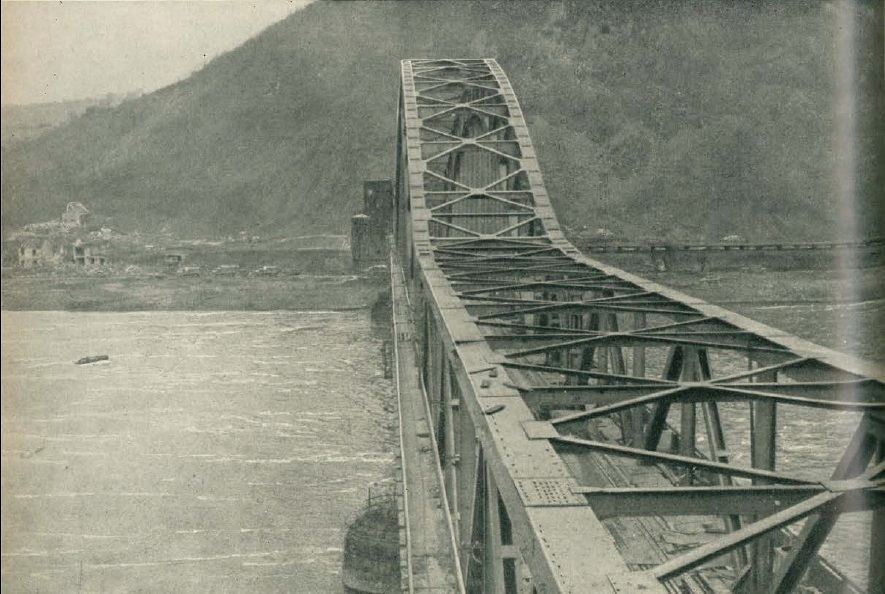
On 07 March Company A of the 27th Armored Infantry Battalion captured the Ludendorff Bridge (Remagen Bridge) intact, and the First Battalion, 310th Infantry of the 78th Division was to be the first infantry battalion over the Rhine.

Their orders that night were simple: “Cross the Rhine, turn right, and attack!”

Ludendorff Bridge before the collapse

Ludendorff Bridge before the collapse

First Battalion was instrumental in creating and holding the bridgehead to the east of the Rhine. On 17 March the Ludendorff bridge at Remagen collapsed, although several other pontoon bridges had been put in place by that time, allowing the Allied troops secure crossings over the Rhine.
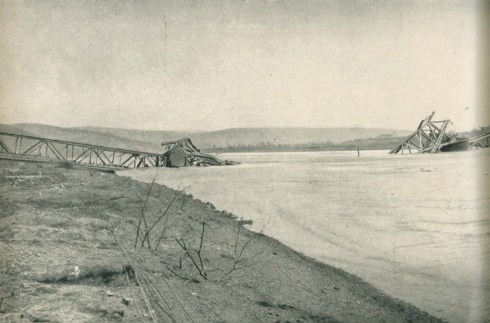
Ludendorff Bridge after collapse

Ludendorff Bridge after collapse

The regiment continued north until it reached the banks of the lower Sieg river. It held position here from 22 March until 05 April and was “a heavenly rest”. Or at least for the rest of the regiment.

It was at this point – on 25 March 1945 – that his service in Europe was to come to an end. There’s nothing explicit in the book that mentions anything. Given the cause of his discharge (“anxiety hysteria”) perhaps that final push north and east of the Rhine was too much for an exhausted body and mind.

By 12 May 1945 he was back on American soil and was discharged officially in Brigham City, Utah.

As well as the battle story, there are some amazing sketches …

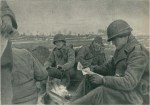
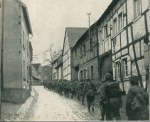
… and frontline photography …

… as well as the sketch maps as already exampled.

The credit to those goes to:

  • T/5 Ralph Delby, a combat veteran from one of [the] line companies drew most of [the] maps and some of the sketches. Pfc. Delby was an art student as a civilian.
  • Cpl. Adam D. Baron, [a] very able and talented cartoonist. A commercial artist in civilian life, he can portray the life of a combat soldier because he has been there.

I wanted to end this post with a letter/poem Corporal Walter Slatoff wrote to his son and appeared in the New York Times:

MORE TERRIBLE THAN ALL THE WORDS

(An American Soldier writes to his Son.)

MY SON:

War is a more terrible thing than all the words of man can say; more terrible than a man’s mind can comprehend.

It is the corpse of a friend; one moment ago a living human being with thoughts, hopes, and a future – just exactly like yourself – now nothing.

It is the eyes of men after battle, like muddy water, lightless.

It is cities – labor of generations lost – now dusty piles of broken stones and splintered wood – dead.

It is the total pain of a hundred million parted loved ones – some for always.

It is the impossibility of planning a future; uncertainty that mocks every hoping dream.

Remember! It is the reality of these things – not the words.

It is the sound of an exploding shell; a moment’s silence, then the searing scream “MEDIC” passed urgently from throat to throat.

It is the groans and the pain of the wounded, and the expressions on their faces.

It is the sound of new soldiers crying before battle; the louder sound of their silence afterwards.

It is the filth and itching and hunger; the endless body discomfort; the feeling like an animal; the fatigue so deep that to die would be good.

It is battle, which is confusion, fear, hate, death, misery and much more.

The reality – not the words. Remember!

It is the evil snickering knowledge that sooner or later the law of averages will catch up with each soldier, and the horrible hope that it will take the form of a wound, not maiming or death.

It is boys of 19 who might be in the schoolroom or flirting in the park; husbands who might be telling their wives of a raise – tender and happy-eyed; fathers who might be teaching their sons to throw a ball – bright with pride. It is these men, mouths and insides ugly with hate and fear, driving a bayonet into other men’s bodies.

It is “battle fatigue”, a nice name for having taken more than the brain and heart can stand, and taking refuge in a shadowy unreal world.

It is the maimed coming home; dreading pity, dreading failure, dreading life.

It is many million precious years of human lives lost; and the watching of the loss day by day, month by month, year by year, until hope is an ugly sneering thing.

Remember! Remember and multiply these things by the largest number you know. Then repeat them over and over again until they are alive and burning in your mind.

Remember! Remember what we are talking about. Not words; not soldiers; but human beings just exactly like yourself.

And when it is in your mind so strongly that you can never forget; then seek how you can best keep peace. Work at this hard with every tool of thought and love you have. Do not rest until you can say to every man who ever died for man’s happiness: “You did not die in vain.”

Cpl. WALTER J. SLATOFF

Reg. Hq. Co. 310 Inf.

Ellis Adams – An Update

I may have mentioned in my last post about my grandfather, Ellis Adams, that I had a sniff of a lead that he died in Virginia. I asked a … easier to say ‘extended cousin’ as the relationship between he and I works out at about 7th cousin 1 x removed … to order a death certificate from the Virginia Department of Health, giving the place of death as ‘Unknown’. Unfortunately the response was “more information, please …”.

As I had his date of death (August 1971) I thought I’d search on the Find A Grave website. In their own words:

Find a Grave’s mission is to find, record and present final disposition information from around the world as a virtual cemetery experience.

Memorial contributions to Find A Grave should fulfill that mission – registration of the final disposition. If the memorial contribution corresponds with only the main mission, then the memorial fulfills its purpose as part of Find A Grave’s mission.

Find a Grave memorials may contain rich content including pictures, biographies and more specific information. Members can leave remembrances via ‘virtual flowers’ on the memorials they visit, completing the virtual cemetery experience.

Find A Grave is a resource for anyone in finding the final disposition of family, friends, and ‘famous’ individuals.

It was here that I found a picture of a grave located in Emmett, Gem County, Idaho …

Ellis Adams' Gravestone, Emmett, Gem County, Idaho

Ellis Adams’ Gravestone, Emmett, Gem County, Idaho

It was also the start of a series of questions. Although the name was correct, and the date of death was correct, the date of birth is off by 9 days. “9 days, is that all?” you may ask. His date of birth of 10 April 1924 is stated on both his application for a Social Security number and on the Social Security Death Index. Error on a gravestone? Quite common, in fact, as its information provided by the purchaser and not checked against any other source. I am currently in the process of purchasing a copy of the death certificate through the US provider VitalChek. And what a pain in the ass that is as a non-US resident! And it’ll leave me $60 poorer … (that’s about £37).

As you can see, the gravestone also lists details of his military career. The listing as Private First Class matches his discharge papers, but it also states that he was part of Company A 310th Infantry Regiment. I hadn’t known any details, so this was a definite plus! I started to research the regiment …

310 Infantry Regiment

310 Infantry Regiment

I learnt that the 310th was part of the 78th Infantry Division, also known as “the Lightning Division” which alludes to the combat record of the division being likened to a “bolt of lightning”.

78th Infantry Division, Shoulder Sleeve Insignia

78th Infantry Division, Shoulder Sleeve Insignia

I then started to research the 310th and 78th in more detail and came across some other details that didn’t quite gel …

Wikipedia (that wonderfully accurate font of all knowledge) states:

…the 78th embarked for the European Theatre from the New York POE on 14 October 1944, whereupon they sailed for England. They arrived on 26 October 1944, and after further training crossed to France on 22 November 1944.

However, if we compare this with dates from Ellis’ life we see that something isn’t quite right.

  • Ellis’ discharge papers state that he entered service outside of the United States in May 1944 and was wounded in battle in July 1944.
  • The date of Ellis and Eva’s marriage is 23 November 1944. Did Ellis go later? Was he held back as he was still recovering from being wounded in July 1944? Questions only his service record would have answered!
  • Given my mother’s birth date, Eva was a month pregnant at the time of her marriage. Using the October arrival date, this gives Ellis a very short window of opportunity to get the ball rolling!

Of course, it may be possible that Ellis started off in a different regiment and was subsequently transferred to the 78th at a later date. The 78th did take part in  the Western Allied invasion of Germany (Central Europe Campaign) and were involved in the Battle of the Bulge, and also the taking of the Remagen Bridge (later made into a film starring George Segal and Napoleon Solo Robert Vaughn).

Ellis was discharged in March 1945, so would not have taken place in the battle of encirclement known as The Ruhr Pocket in May 1945.

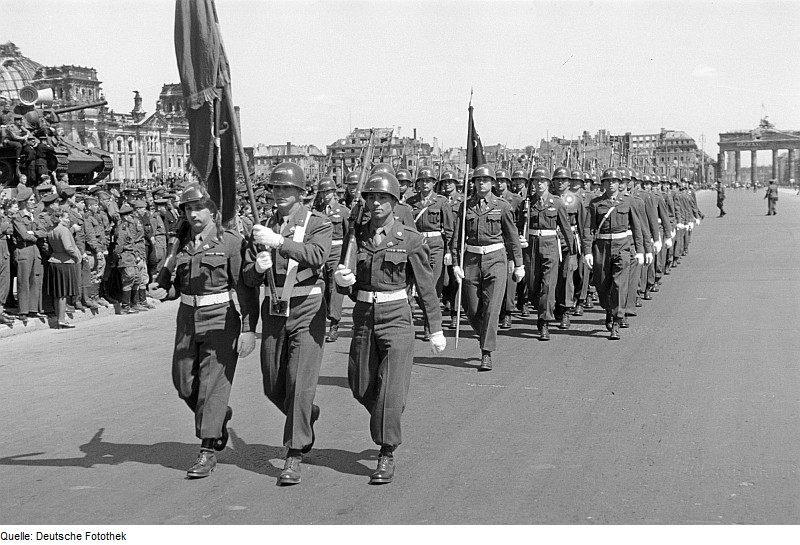
78th Infantry Division. On parade in Berlin, 8 May 1946

78th Infantry Division. On parade in Berlin, 8 May 1946

Perhaps once I receive a copy of the death certificate it may lead to some new information regarding a new family in Idaho. In the meantime I have contacted the Idaho State Archives and the offices of the local newspaper, the Emmett Messenger-Index, to see if they hold an obituary for him (assuming that he died in the same town that he was buried). So I guess its another waiting game to see what the Gem State (or Potato State, depending on what you prefer) holds!

Operation War Bride

As previously mentioned, my own grandmother wasn’t able to join her husband in America following WWII. However, Eva wasn’t the only member of my mother’s family to succumb to the charms of an American GI.

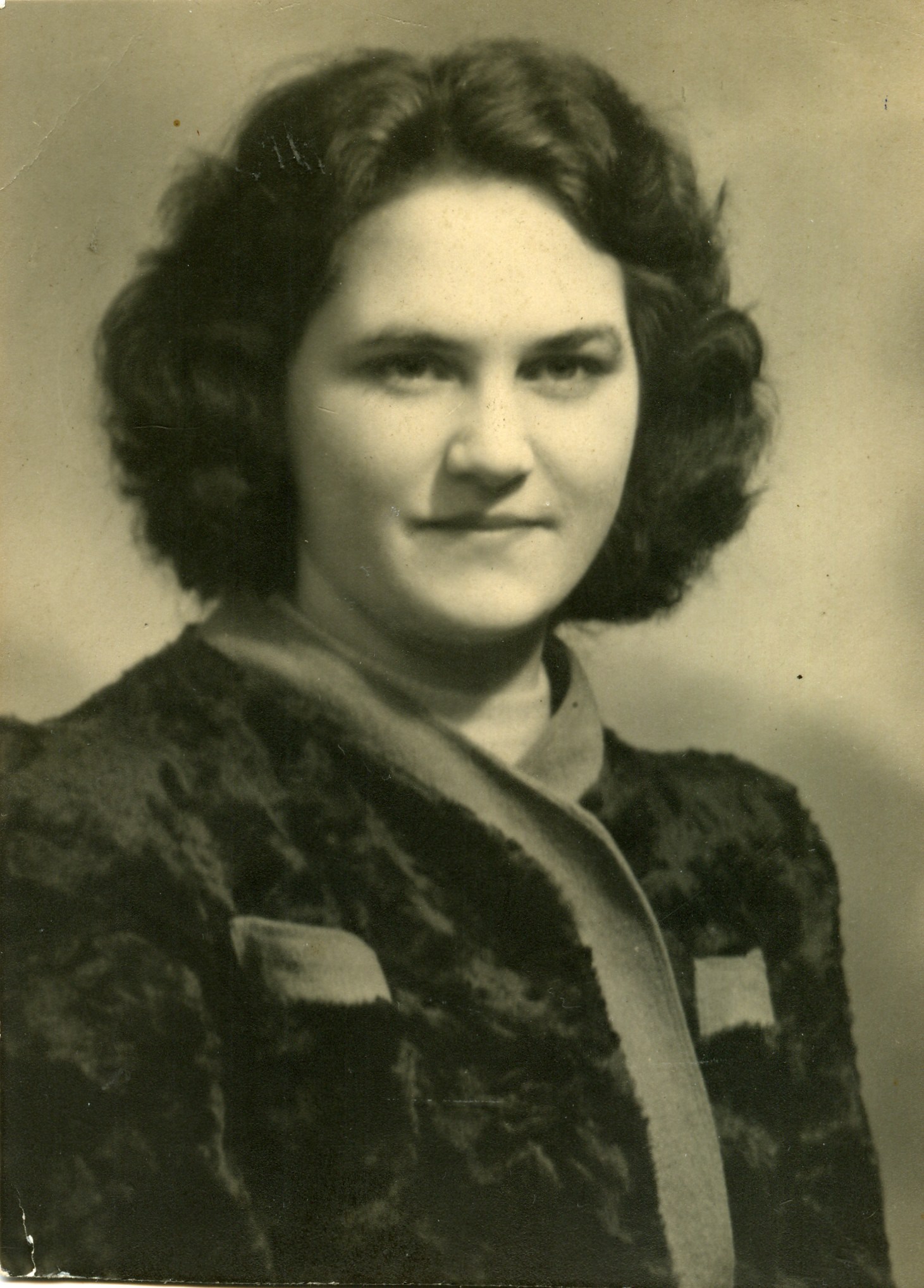
Eva’s mother, Edith, was 18 years older than her youngest sibling, Barbara. Barbara Joan Hurcombe was born in a small Gloucestershire village of Tresham in 1920, and was just five years older than her eldest niece, Eva (my grandmother).

Barbara Joan Hurcombe

Barbara Joan Hurcombe

Where exactly Barbara met her husband-to-be isn’t known at this time, but it would be easy to assume that he was barracked at Le Marchent in Devizes, Wiltshire.

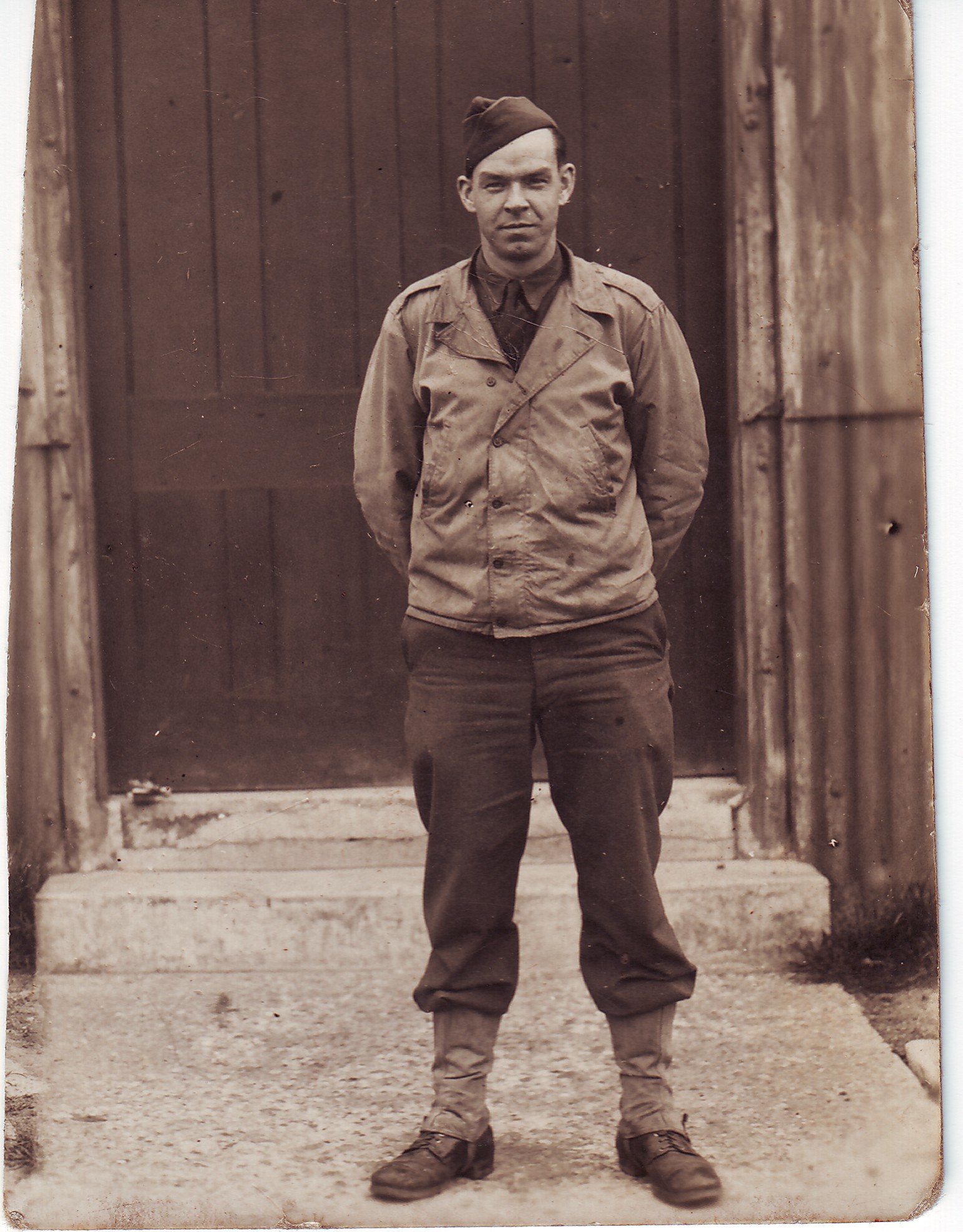
In late 1943, Barbara married Emmet Joseph Ryan.

Emmet Ryan

Emmet Ryan

A few months later, in February 1944, their son, Philip, was born. (Eva would marry Ellis in November 1944, and Veronica would be born in June 1945.)

Barbara (left) with son Philip. Eva (right) with daughter, Veronica

Barbara (left) with son Philip. Eva (right) with daughter, Veronica

In December 1945 US Congress passed the War Brides Act. This  allowed the non-Asian spouses (the race restriction was not lifted until 1952), natural children, and adopted children of United States military personnel to enter the U.S. after WWII. It also promised that their wives and babies would be delivered to their doorsteps free of charge. A military movement which was dubbed Operation War Bride started a few months later, and the first batch of 455 brides and 132 children arrived in New York in February 1946. Its estimated that around 70,000 British women left England to follow their husbands.

The War Brides were gathered from around the country and were taken to:

… a military base used as a bride-processing center in Tidworth, in southern England. The women lived in barracks and took meals served by German prisoners of war in the mess hall.

I don’t know if Barbara traveled to Tidworth to be ‘processed’, as she lived close by.

Queen Mary Passenger List

Queen Mary Passenger List

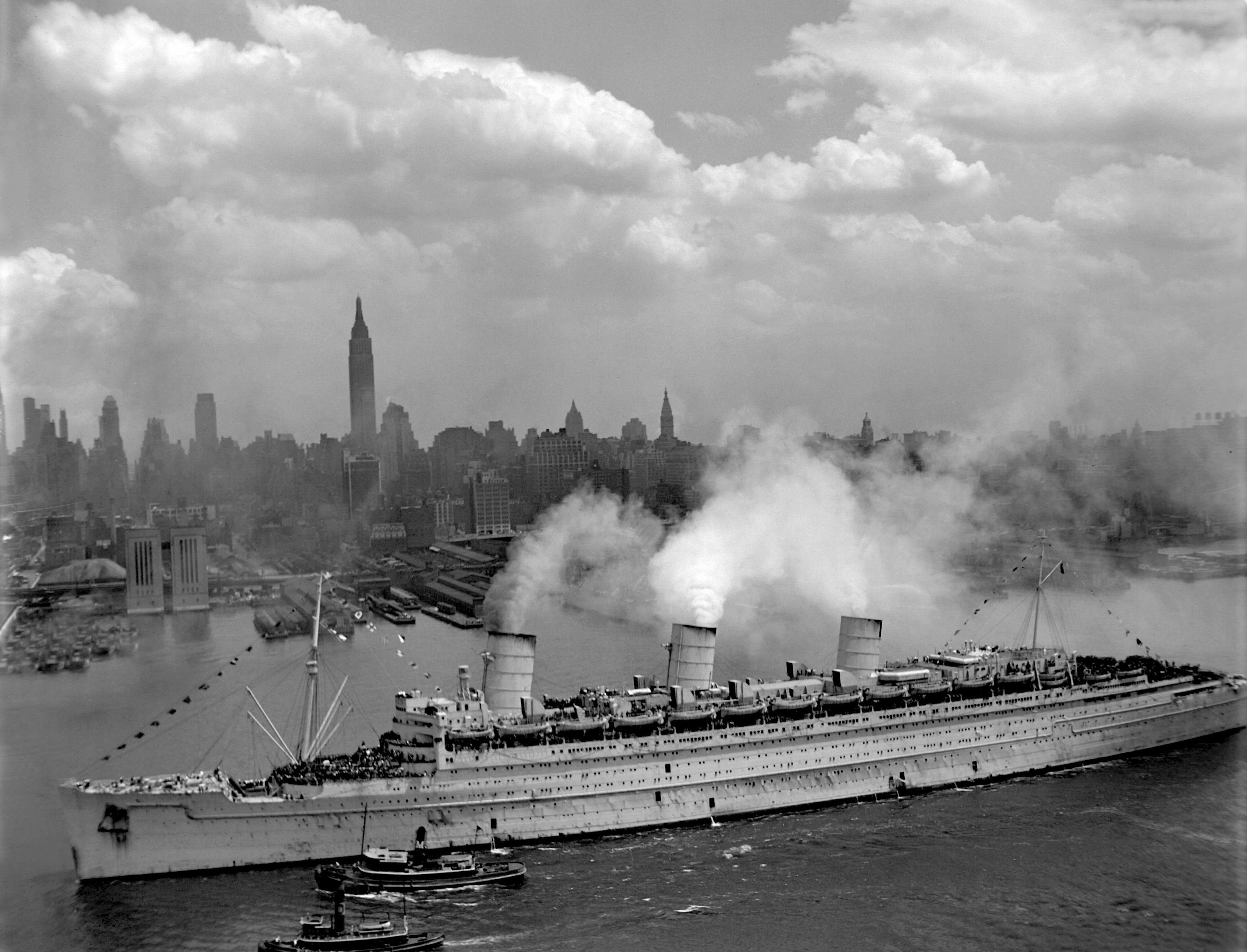
What I do know is that on 31 March 1946 she left Southampton bound for New York. She and her son Philip were travelling aboard the RMS Queen Mary. They arrived in New York on 4 April 1946.

RMS Queen Mary, New York, June 1945

RMS Queen Mary, New York, June 1945

I have no details on Emmet’s army service, or of their life after the war. In the 1940 census he is listed as a plasterer. They did go on to have a set of twin boys, and remained living in Syracuse, New York, where Emmet had been born and raised.

I was able to share a few letters with Barbara (or Joan, as she was known) before she passed away in 2011. She had been a widow for over 30 years following Emmet’s death in 1978. Unfortunately we were not able to share any details regarding her meeting Emmet or her early years in America.

Hopefully, in time, I can reconnect with her family and find out more details!

Grampy Otto

I have a few overriding memories of my grampy.

The first is that of his sneezes – they came from nowhere and rocked the room, scaring the bejesus out of me as a child.

The second is of my gran calling him “Frizzel” – a term of endearment created from his surname.

As mentioned in a previous post, I grew up knowing that he was German and had been a POW – which is how he’d met my grandmother. I also knew that his family were from what was the German Democratic Republic from 1949 to 1990 so communication was … limited.

I never asked him about his childhood in Germany, where he was from or what he did in WWII. One of the many regrets that haunt the background of genealogy. “I should’ve asked … Why didn’t I … If only …”

I do have a few bits and pieces, from here and there, that I’m going to share.

As previously mentioned, I had ordered a copy of Otto and Eva’s marriage certificate, and this showed his father was Laudislaus Frysol, a Parish Nightwatchman.

Erich Otto Frysol

Erich Otto Frysol

One of my uncles has Otto’s Reichspass, and from there I was able to add to what I know.

Erich Otto Frysol was born on 01 March 1921 in Paproc, Poland. Had he been born three years earlier, he would’ve been a subject of the Prussian Province of Posen. It wasn’t until the Treaty of Versailles in 1919 that the area came back under Polish control, and the final borders of Poland weren’t ratified until 1921. Germany once again invaded Poland in September 1939, and he became a subject of the Third Reich.

Two younger sisters were born – presumably also in Paproc: Luise Elfride Gisela Frysol in 1925 and Martha Luise Frysol in 1933.

I wrote to a niece of Otto, a daughter of his sister Martha (known as Luise – Luise was known as Gisela), who confirmed that their parents were Ladislas Frysol and Anna Gleissner. Ladislas was one of four children, and Anna had 11 siblings. She was also able to give me the names and details of her own branch of the family. The elder sister married an older man but never had children of her own.

Descendant Chart for Ladislas Frysol

Descendant Chart for Ladislas Frysol

Knowing that Otto had been a POW in England during WWII, in 2008 I wrote to the International Committee of the Red Cross, asking for their assistance. Unfortunately they didn’t have anything in their files, but suggested I contact the Deutsche Dienstelle (WASt) in Berlin.

They maintain the records of members of the former German armed forces who were killed in action. Formerly called the Wehrmachtsauskunftstelle (WASt) this agency also provides information about the fate of foreign and German soldiers as well as prisoners of war in Germany.

I received a letter back, stating that they had information regarding his military career in the Navy.

Service Period: 15 February 1943 – 08 May 1945 (date of German surrender)

For the first 3 months, he was a recruit, at first in Buxtehude, Lower Saxony, and then at the garrison in Husum, Nord-Friesland. This was for the 2 and then 18. Schiffsstammabteiling (essentially personnel training and depot units, recruits received their basic military and nautical training).

06 May 1943 – 15 August 1943 – Training for the Stützpunktabteilung (“Base Department”) in Cuxhaven, at the mouth of the Elbe River.

16 August 1943 – 26 November 1943 – Harbour Protection Flotilla Gironde. The object of the flotilla was to monitor and secure the coastal zone , such as mine clearance , outpost and escort duties. From mid- 1943, the existing port protection flotillas were resolved to saving personnel.

27 November 1943 – 28 February 1944 – Transferred to “Headquarters Company” in Paris, Personalbereitstellung ‘Porterage Service’.

29 February 1944 – 08 May 1945 – Hafenkommandant St Malo bzw Festung Kanalinseln – which I think (well, Google thinks) translates as “Port Commander St Malo or Fortress Channel Islands”.

Looking at the awards he received, there are two.

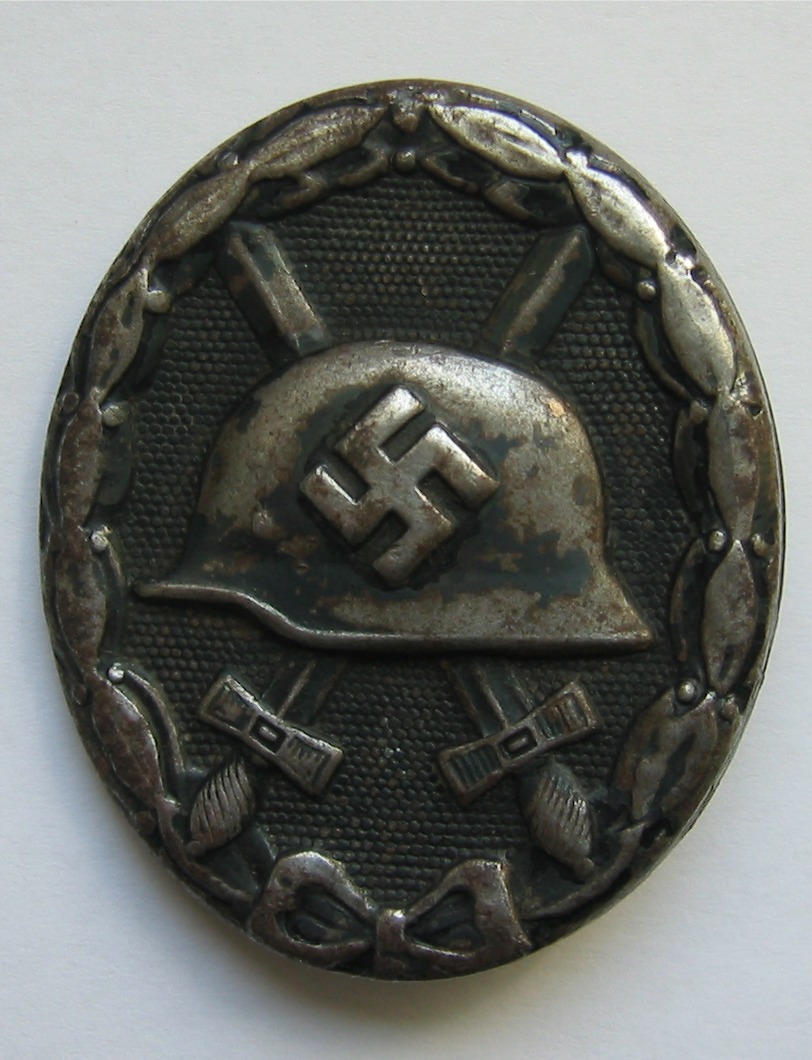
The first has no date marked, but was received for: “War Badge for mine detection, U-boat-hunting and security associations”. The second was received on 23 August 1944 and was the Wound Badge (Black).

German Wound Badge in Black

German Wound Badge in Black

These were awarded when a member of the German Armed Forces was either frostbitten in the line of duty or wounded by enemy action. The badge had three classes: black (3rd class, representing Iron), for those wounded once or twice by hostile action (including air raids), or frostbitten in the line of duty; silver (2nd class) for being wounded three or four times, or suffering loss of a hand, foot or eye from hostile action (also partial loss of hearing), facial disfigurement or brain damage via hostile action; and in gold (1st class, which could be awarded posthumously) for five or more times wounded, total blindness, “loss of manhood”, or severe brain damage via hostile action.

Family lore has it that Otto was wounded whilst in St Malo. Given the dates, it would appear that he was not wounded in the battle for the liberation of St Malo, which was completed on 18 August 1944, but may have been located on Ile Cézembre – a fortified island off of St Malo that was part of the Atlantic Wall. It was heavily bombarded by land artillery, naval artillery, and air strikes, including some of the first uses of napalm bombs. The island eventually capitulated on 2 September 1944.

The letter ends by saying:

Your grandfather became on 08 May, 1945 in British captivity, from which he was released on 31 December, 1948.

Was he captured in St Malo? The date of his Wound Badge seem to indicate he was around that area at the time of the Normandy invasion, and the number of German POWs in the UK increased dramatically at this time, or was he not taken until the end of the war, as the letter seems to infer? Difficult to say for sure either way.

I do know that he was one of the over 400,000 German POWs held in Britain by 1946, and one of the 170,000 POWs undertaking agricultural work. It was through this work, working on farms in Wiltshire, that he first met my grandmother, Eva.

Following the end of the war:

“… many prisoners were soon on their way back home but a programme of re-education was devised to supposedly prepare the prisoners for a new life in a different Germany. The full horrors of the Holocaust were put on show and one prisoner who was at the time a hard-line Nazi remembers that many of his comrades did not believe that the Holocaust had taken place,  thinking it was British propaganda designed to shame the German people even more. This process of re-education determined whether a prisoner would be sent home early or not and interviews took place to determine the prisoners attitude. Many who at first showed contempt for the British realised that the war was now over and the only way to secure their release was to change their attitude. Many did and the first repatriations took place in 1946. Some were less flexible however and at these interviews (which took place every six months) would show their loyalty to the Nazi regime by marching in to the interrogation room and giving a Nazi salute to the British officer present which would mean a further six months in captivity.”

The last prisoner repatriations took place in 1949 but approximately 25,000 prisoners decided to stay in Britain where they became known as “DPs” or displaced persons. Others married local girls and stayed in Britain.

Otto and Young Veronica, Easton Royal

Otto and Young Veronica, Easton Royal

Whatever his reasons, Otto also remained in Britain and married Eva in 1953.

Do I wish he and I could have spoken about what had happened to him? Yes.

Do I understand why we didn’t? Definitely.

I’d still like to know more about the Frysol family. The only extant ones with that spelling I can find in records online are all my family. One of the items on my genealogy To Do list is to employ a Polish researcher to find any baptism records for Otto and his sisters to gain a fuller understanding of his family unit, and then work backwards from there.

Until then … this one’s for you, Grampy.

Otto and Veronica, Wedding 1967

Otto and Veronica, Wedding 1967

Grandfather Stanfield … er, Payne … er, Tisdale …

So now I’ll turn my attention to the search for my father’s father, which in a lot of ways was easier than looking into my other grandfather’s family.

My mother had for a long time kept a letter that had belonged to my father’s mother, Norah, and had been written by a lady called Geneva. The letter talked about “Bob” wanting to keep in contact with his son. From this letter I learned a couple of important things – that my father’s father was Robert Stanfield, that he’d married after the war to a lady called Geneva, and also a geographic area of the USA in which to concentrate any searches – Battle Creek, Michigan.

(more…)