Who’s The (4 x Great-Grand) Daddy?

On 14 January 1852 my 3 x great-grandfather, Thomas Halliday Hurcombe, was born.

When I was first researching my family history – apart from putting out feelers regarding my American grandfathers – the Holborow/Hurcombe lines of my mother’s ancestry marked my initial steps into this world. My mother was very close to her maternal grandmother, Edith May Holborow nee Hurcombe, and also to Edith’s parents, Alfred William Hurcombe and Harriet nee Robins, so it seemed fitting that I started here.

Back row, l-to-r: Eva, Edith, Ver.  Front row, l-to-r: little me(!), my brother Alex

Back row, l-to-r: Eva, Edith, Ver.
Front row, l-to-r: little me(!), my brother Alex

I’ve always relied on the kindness of strangers (especially about 2am when the lights come on, but that’s a different story), and starting the genealogy journey I was somewhat suckered in to the use of other people’s information over finding things out on my own with the actual records. Consequently, I was happy enough when I found information regarding Alfred’s father, Thomas Halliday Hurcombe.

Alfred & Harriet Hurcombe, near Devizes

Alfred & Harriet Hurcombe, near Devizes

Thomas’ mother was quickly identified as Ann Hurcombe, formerly Halliday, and his father as Stephen Hurcombe. Stephen was somewhat older than Ann, being born on 13 January 1799 in Leighterton, Gloucestershire. In fact, records show that he had been married before. On 13 December 1823 he first married spinster Jane Davies and they had two children: David (27 February 1825 – 8 May 1857) and Mary (10 December 1826 – 12 May 1846). Four months later, in April 1827 Jane died.

After several years, the 36-year-old Stephen married 19-year-old Ann Halliday on 12 October 1835 in Leighterton. Ann brought another child into the family – a one year old son, George Marsh Halliday. Ann hadn’t been married before Stephen, but there was a prominent farmer in the village called George Marsh. Whilst I can’t prove anything, it may be a case that George senior fathered a son on the young Ann who then named the son after the purported father.

Stephen and Ann went on to have a number of children:

  • Elizabeth: 21 Aug 1836 – 1918
  • Emanuel: 03 Feb 1839 – 1922
  • Emily: 11 Apr 1841 – 08 Jun 1851
  • David Henry: 24 May 1845 – 10 Jan 1919

…and it was during this research, after tracing the Hurcombe line back a further couple of generations, that I came upon the death entry for Stephen: 28 March 1850.

As Thomas wasn’t born for another almost two years, it would be extremely unlikely for Stephen to be his father – as so many people had presumed and slavishly copied down (and, in fact, Stephen can still be found listed as Thomas’ father in online trees despite this glaring error in mathematics – and I doubt that Ann concentrated on the wallpaper that hard for two years …).

Other than using both her maiden and married names in her son’s name, there is no additional clue as to the identity of his father. Ann would go on to have another illegitimate son, Alfred Thomas Halliday, in 1859. Despite having been registered as a Halliday at his birth, in 1889 when Alfred married, he did so under the name Alfred Hurcombe, and appears in all of the relevant census as such. His children were all baptised with the surname of Hurcombe.

Aged almost 60, in January 1876, Ann married a Chelsea pensioner named Peter Adams – who was 13 years her junior, reversing the earlier age difference with her first husband!

Descendant Chart for Ann Halliday

Descendant Chart for Ann Halliday

So who was the father of Thomas (and Alfred)? His birth certificate simply has a line in place of father’s name. Contact with other Hurcombe/Halliday researchers mooted that at least one of the fathers may have been a younger brother of Stephen’s called David – but that is sheer speculation, and without anything such as bastardy papers we will perhaps never know how much of a Hurcombe Thomas and his (half) brother Alfred were.

Thomas went on to marry Emily Raines in the Tetbury Register Office on 17 February 1974, and the pair had 7 children – their third child (and third son) was Alfred William, my 2 x great-grandfather. He passed away on 13 March 1927 in Leighterton, with Emily following on 26 January 1938.
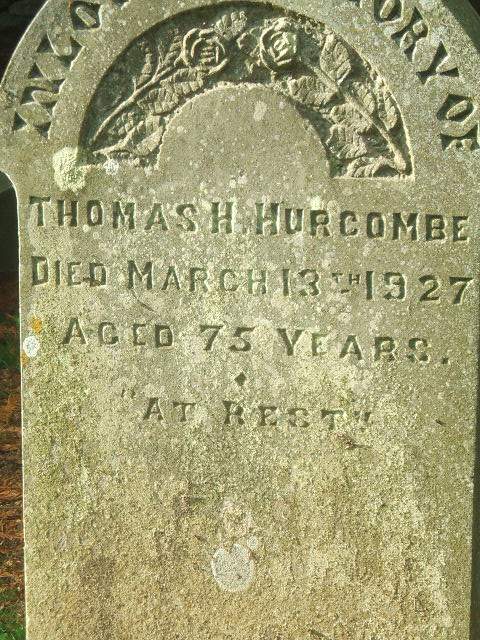
Gravestone of Thomas Halliday Hurcombe

Gravestone of Thomas Halliday Hurcombe


John Norris

I was having a wander through my family tree, trying to find an ancestor or family to share with you. I was reminded, on my father’s mother’s side of the Norris family of Collingbourne Kingston, Wiltshire, and after reacquainting myself with the line found a rather surprising association.

Emily Alice Palmer has been mentioned before – and her less than ‘traditional’ life that she lived. Her maternal grandmother was named Priscilla Brine. Her great-grandmother was Mary Norris. Her great-great-grandfather was John Norris. (Are you still with me, generation fans? We’re back to my 10 x great-grandfather now!) He had been made vicar of Collingbourne Kingston in 1647 and in August 1660 moved to Aldbourne in Wiltshire. It was here that he died on 18 March 1682, and was survived by his wife, Elizabeth.

Searching the Clergy of the Church of England Database (CCEd), John obtained his BA from Pembroke College, Cambridge on 17 June 1636 and his MA on 2 May 1639. What little evidence there is seems to show that he was a Calvinist (that is, a form of Protestantism based on the Reformation-era teachings of John Calvin). He and his wife Elizabeth had 5 children, 3 of whom survived into adulthood.

I am descended from his son Henry, who seems to have remained in Collingbourne Ducis, marrying Catherine Hellyard on 16 October 1674 and having at least five children.

Henry’s brother John – born on 2 January 1657 in Collingbourne Kingston – seems to have taken a quite different turn with his life. Educated first at Winchester College, he entered Exeter College, Oxford in 1676. He read classical literature widely, but was drawn to the writings of Plato, Xenophon and Aristotle and was drawn to various metaphysical and mystical teachings. He obtained his BA in 1680 and became an elected fellow of All Souls. He also discovered the works of the rationalist philosopher Nicolas Malebranche and his work Search after Truth (aka ‘Concerning the Search after Truth. In which is treated the nature of the human mind and the use that must be made of it to avoid error in the sciences’ – which I think we can agree is a most snappy title …). In 1684 he took his MA and was ordained.

St Andrew's Old Church, Bemerton in 1994. © Copyright Nick Macneill and licensed for reuse under this Creative Commons Licence

St Andrew’s Old Church, Bemerton in 1994. © Copyright Nick Macneill and licensed for reuse under this Creative Commons Licence

In 1689 he left Oxford and married his wife, Elizabeth. They moved to Newton St Loe near Bath in Somerset where he was the vicar. It was here that he wrote a critique to John Locke’s An Essay on Human Understanding. In 1692 the Norris family moved to Bemerton, Wiltshire (just outside Salisbury) – a position that Locke had recommended him for. The two Johns (as it were) had a mutual friend in Lady Damaris Cudworth Masham, a philosopher and feminist in her own right. She argued that mothers were essential to the well-being of political society and also advocated women’s participation in disciplines long dominated by men: sciences and philosophy.

Although the friendship between John Norris and John Locke and Lady Masham didn’t last (and Locke dismissed him from serious consideration, describing him as “an obscure, enthusiastic man”), he was a close friend and supporter of other learned ladies, such as Elizabeth Thomas and Lady Mary Chudleigh. His closest friendship here was, however, with Mary Astell.

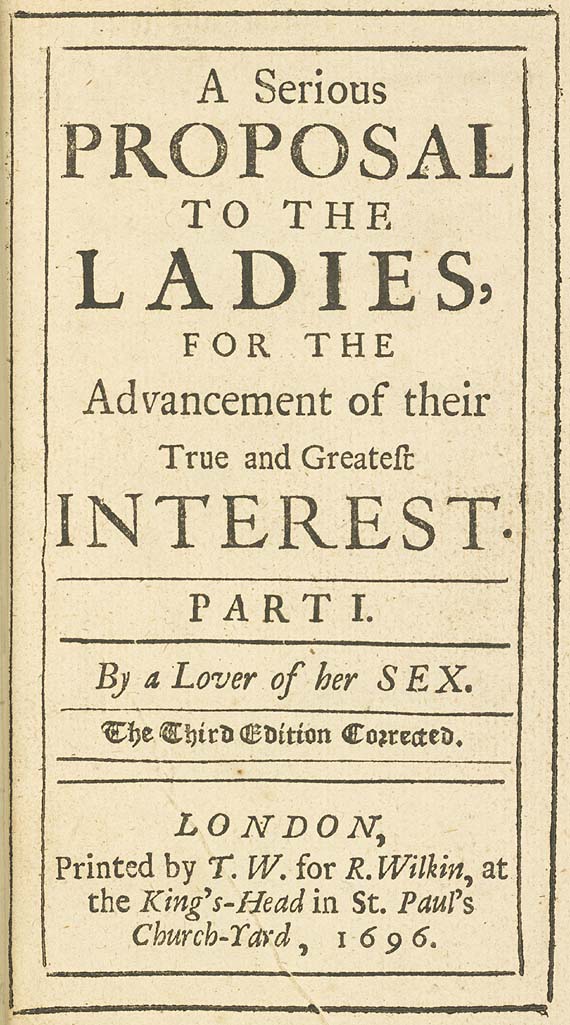
Title page from the third edition of A Serious Proposal

Title page from the third edition of A Serious Proposal

Mary had received an informal education from her uncle, who had left the clergy due to bouts of alcoholism, but introduced her to the works of Plato and Aristotle. Following the death of her father, mother and aunt, she moved to London and came under the patronage of various women, including Lady Elizabeth Hastings, the daughter of the 7th Earl of Huntingdon (Elizabeth and Mary would both die after having a mastectomy following breast cancer). It was under their aegis that she was able to develop and publish her works on the importance of marriage equality and education for women – so much so that she presented an idea of women having the same religious and secular education as men, ideally in a protected environment. Jonathan Swift (he of Gulliver’s Travels fame) mocked her, and Daniel Defoe (yes, Robinson Crusoe) called them “impracticable” – but this didn’t stop him from using almost the exact same idea in a later essay of his.

The more I read about Mary Astell, what she overcame and how she managed to debate freely with some of the most learned men and women of her age, the more I wonder why more isn’t known about her, and other like her. (The answer is, I feel, somewhat obvious.)

One of her key quotes is the following, from her book Some Reflections Upon Marriage:

If all Men are born Free, why are all Women born Slaves?

She had a great many good things to say about John Norris, including the following:

…though some morose Gentleman wou’d perhaps remit me to the Distaff or the Kitchin … yet expecting better things from the more Equitable and ingenious Mr. Norris, who is not so narrow-Soul’d as to confine Learning to his own Sex, or to envy it in ours, I presume to beg his Attention a little to the Impertinencies of a Woman’s Pen.

She wrote in 1694: “Women are from their very Infancy debar’d those Advantages, with the want of which they are afterwards reproached …They are] nursed up in those Vices which will hereafter be upbraided to them. So partial are Men as to expect Brick where they afford no Straw. … How can you be content to be in the World like Tulips in a Garden, to make a fine shew and be good for nothing?”

She urged women to be scholars and poets and to strive for excellence, arguing that the life of the mind was “a Matter infinitely more worthy your Debates, than what Colours are most agreeable, or what’s the Dress becomes you best”. She encouraged women to aspire to higher things than “to attract the Eyes of Men. We value them too much, and ourselves too little, if we place any part of our desert in their Opinion; and don’t think our selves capable of Nobler Things than the pitiful Conquest of some worthless heart.”

#YesAllWomen indeed.

For my own part, and as non-religious as I am, I have to say that I am proud of John and his cultivation of not only his own education but also the support of the notion that women are – shock, horror – just as capable of rational thought as men. In their correspondence, he and Mary agree that as bodies have motion, so minds have love.

I’m not sure I can add anything to that.

 “How fading are the joys we dote upon!

Like apparitions seen and gone.

But those which soonest take their flight

Are the most exquisite and strong—

Like angels’ visits, short and bright;

Mortality’s too weak to bear them long.”

John Norris, The Parting (1678)

For more on John Norris:

Encyclopaedia Londinensis entry

Oxford Dictionary of National Biography entry

Wikipedia

For more on Mary Astell:

Stanford Encyclopedia of Philosophy

Oxford Dictionary of National Biography entry

Wikipedia

Following The Path

I am a little bit excited about this week’s genealogy post as it also marks my first ever guest post! The eponymous travelling lady behind the fabulous The Travel Lady In Her Shoes kindly agreed to do a bit of a write-up regarding her journey of discovering her family history …

It seems to me that no one studies their genealogy until you are the last one left. Or maybe one just gets older and the END/BEGINNING is nearer and one wonders “where in the world did we come from?” This was the case for me anyway. Both my parents had passed and I realized I knew very little about my families and I wanted to leave SOME imprint to my children and grandchildren. So I started to search. The first thing I did was go to my father’s older sister, a woman I hadn’t seen since I was a child. If anyone knows a good way on how to land on your relative’s doorstep after 50+ years to ask for family information, please let me know! I just called and showed up. I think it helped that my father was well liked. My aunt had photocopies and booklets made of family reunions from way back, way before my time. I was thrilled to see these since I didn’t know these papers existed and even more thrilled that my aunt let me take the entire caboodle to copy and then mail back to her! I had pictures! I had stories! I had names!

I was hooked!

photo-0122-2014-family-normal

The big challenge that many Americans face is the mobility of our society. I do not live where I was born, not even in the same state. Neither did my father or mother, neither did my grandparents. So it’s not like we were seeing our relatives frequently. So growing up I got pieces of this and that, only from my father, mostly when he was drinking. Not a word was ever said about my mother’s family. I was in high school before it was revealed that my mother’s parents and siblings were alive. More on that story later.

My first shock was the fact that most of the knowledge of the family from my father was true. Not entirely accurate, but close enough. These were stories passed down from one generation to another. These stories were documented in my aunt’s papers. I never thought too much about the fact that unless you are a Native American, your family came to this country from somewhere else. It was interesting to learn that my father’s family came here in 1843. At the time, I thought that was a long time ago! The other interesting fact is that most families had their surnames changed on immigration, due to the fact that the processors could not understand the many languages, so they wrote down the immigrants names as it sounded to them. Also, because the new arrivals wanted to fit in, as quickly as possible, they also changed their first names to English names. So I learned our surname had been changed and my great-grandparents spoke German, which was true. My father had always said this. He also said that his grandparents came from Alsace Lorraine, on the border of France and Germany.

I found my great-grandfather’s entry into the U.S. from Hamburg, Germany, on the ship “John,” with his mother, father, uncle, brother and sister. Within a year his father had died, his uncle returned to Germany, and my grandfather was separated from his mother, brother and sister when he was sent to work on a farm as a laborer. He never saw them again. He was 14 years old. He met my great-grandmother many years later. She was a German speaking immigrant also and on her family’s immigration papers it states her family came from Weiler, Germany, or on some documents Savern, Germany, in 1856. I looked and looked for Weiler and Savern, Germany! Thanks to a member on Ancestry.com a gentleman told me to look in France for Weiler. There it was, Neuwiller-lès-Saverne, France! In the Alsace region – sometimes France sometimes Germany! The French Ancestry member also told me there was a genealogy center in Saverne, France and I should contact them for information. So I wrote them a letter, stating the name of my great-grandmother, where she was born and what year she immigrated. That was all the information I had.

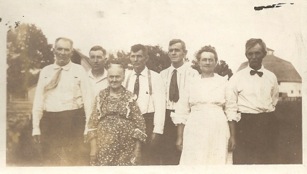
Elizabeth Zimmermann Denhart, who immigrated from France in 1856, that I wrote about in my piece, with four of her sons and one of her daughters.

Elizabeth Zimmermann Denhart, who immigrated from France in 1856, with four of her sons and one of her daughters.

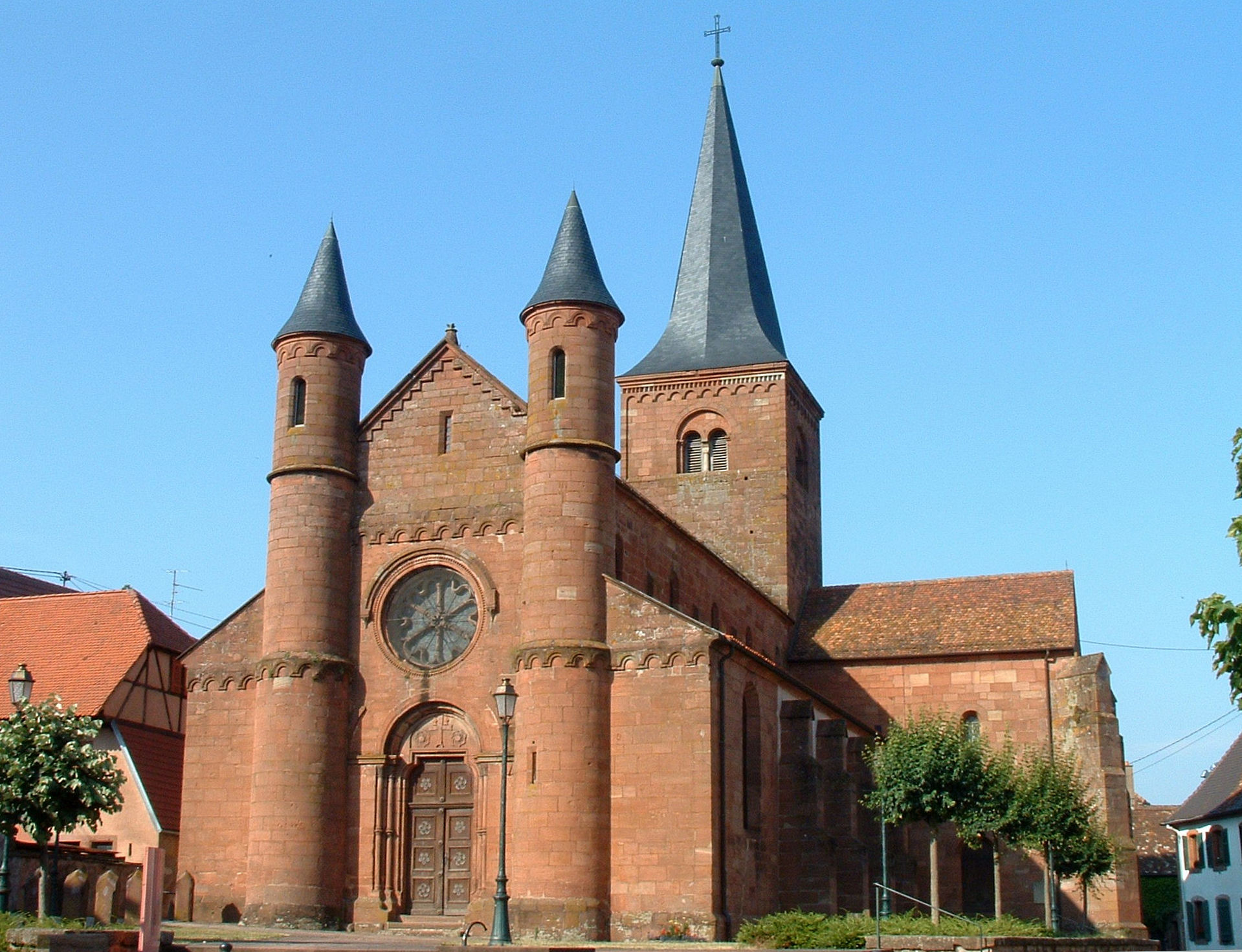
Then I went to France on vacation and made plans to go to the genealogy center and to Neuwiller-lès-Saverne. Imagine my shock when I got to the center, not far from Neuwiller-lès-Saverne, to find the genealogist had traced my great-grandmother’s family and their siblings back to 1600! Also, there was a couple from Neuwiller-lès-Saverne, genealogists who helped families trace their trees in France, there to talk to me! They were elderly and spoke German, French and a little English. They were thrilled that I had traced a family back to their village! So I went with them to Neuwiller-lès-Saverne, and they showed me family graves in the Protestant graveyard. The Zimmermann family had lived there for centuries!

Saint-Adelphe Protestant Church, Neuwiller-lès-Saverne

Saint-Adelphe Protestant Church, Neuwiller-lès-Saverne

They took me to the church. The village was really small with a few farming families still living there. I asked them if they knew why my family had emigrated. A cloud came over the old man’s face. “They were Calvinists,” he replied. “Not allowed to live in the village proper.” The church had helped them to emigrate. I got to thinking what it would take for me to up and leave my country, my family, my friends, taking only the clothes on my back and go to a new home in a far away country, not speaking the language and at the mercy of people I did not know. It would take a lot. These people wanted something better and were willing to give up everything. Tracing the family after the arrival to the United States I found the children marrying Irish immigrants, Scottish immigrants, and other Germans, mostly working at farming, but after the 1920’s moving to the cities to work in factories. I still correspond with the French genealogists from Neuwiller-lès-Saverne, the French man who pointed me in the right direction of Neuwiller-lès-Saverne, even meeting with his family and touring Colmar with them. And I renewed a family tie with my aunt that lasted until her death in 2010. You never know where your finds will take you!

My mother’s story was such a tragedy. WWII had such a toll on so many people. It was heartbreaking and I learned the entire story long after my mother and father’s death, meeting with my mother’s older sister and going to the courthouse to get all the facts. My aunt was hesitant to tell the story; I believe she felt a betrayal of sorts since her younger sister had kept the secret for such a long time, who was she to repeat it? But get the facts I did and it made me want to know about my grandparents, their upbringings and family history.

My grandmother was a Lee and my grandfather a Jones. Can you be any more English?! Their families, especially the Lees, were relatively easy to trace because that family had been here a long, long time. Basically, they had lived in only four states from the time they arrived in the U.S and never strayed very far from other relatives. My surprise was the English families only married into other English families and most of them were well established in the U.S. too. I discovered the families were large, usually twelve or more children, to work the farm and they all named their children the same names! There might be a family with 12 children, Mary, John, Catherine, Polly, Charles, etc. who all have 12 children naming them Mary, John, Catherine, Polly, Charles, etc. So you end up with a bazillion children very close in age to their cousins of the same name and age! What a nightmare to discern!


However, I got lucky in one family who always passed down the name of Greenberry. Green Lee, Mary Berry Lee, Sarah Greenberry Lee, Greenberry Phillip Lee, you get the picture. I finally traced the family of Greenberry’s back to the original Mr. Green and Miss Berry! It’s amazing how families can focus on a name! I was surprised to learn that my name Cady was a continuously passed down name. My Lee family was traced back to the Robert E. Lee descendants and that family has been so well documented it was easier to trace my English roots. So I set off to find Kinlet in Shropshire and the Blount family home.

Humphrey Lee (great-grandfather to Richard Henry Lee who came to the U.S.) married Katherine Blount in 1531 in Coton Hall, Nordley Regis, Shropshire. I did not know enough about getting records or such in England so I set out to find their home origins as a first step. As with most Americans the hardest time I had in England was threefold:

1. Driving on the opposite side of the road and car than I am used to.

2. Arriving in bustling London, when I come from a town of 11,000, where we don’t even get mail delivery.

3. Confused, because we speak the same language, but I had trouble understanding what people were saying. When I got to the smaller villages, things went much more smoothly! Since the Lees had left England a long time ago, I was not sure just what I would find. I wrote about it in my post Meet the Family.

2168085_d63af057

Present-day Coton Hall, built c.1800

There is much more to discover in England, so I am looking forward to another visit to Shropshire and to stay in one place long enough to meet the locals and glean more local information. I look forward to finding (I drove around, but was unable to find) the birthplace of Richard Henry Lee, born 1613, at Coton Hall, Nordley Regis, in Shropshire. I am also wanting more information on Ann Owens Constable, his wife. I know Coton Hall still exists, it was listed for sale a few years back! Slightly out of my price range! If you have any information that might be helpful to me, please let me know!

CadyLuckLeedy@icloud.com

Charles Victor Hurcombe

I thought I’d follow up last week’s ‘Ancestor Of The Week’ with another that was inspired by his hair (although I have to say that although he isn’t an ancestor – he’s my 2 x great-uncle – the photo beautifully illustrates the power of genetics).

(more…)

Adoption Story

This article was inspired by two things. Firstly, an article I read on the BBC website this week: Longest-separated twins find each other. Secondly, this post by Alex at Root To Tip.

Adoption is often a very emotive issue, and there are arguments both for and against those wishing to seek out their birth parents or children given up for adoption. Whilst I have no direct experience with adoption – you have to go back a few generations on my father’s side before you get to any – I do have some with researching the adoptions of others.

Continue reading

Mirth in Wartime

I was looking for something to do with WWI yesterday and came across this brilliant German postcard from around 1918.

Mirth in Wartime

Mirth in Wartime c.1918

Vintage real photo postcard, c.1918, written (as yet untranslated), uncirculated, divided back, photograph by Photohaus Emil Wünsche Nachf., Dresden, Germany.

© Casas-Rodríguez Collection, 2010. Some rights reserved.

Ernest Arthur Cartlidge

Some photographs deserve investigation. They draw you in. Perhaps its a look of happiness on an engagement, or pride in a child, or even a family group. Then you have the photos that are a bit … odd. And that brings us to my husband’s great-grandfather: Ernest Arthur Cartlidge and the photo below.

scan0018

“Yours Ernest Cartlidge in By The Way”


Suffice to say, Ernest wasn’t a Cossack from the lower Dnieper basin. He was born 05 January 1888 in Battersea, Surrey. His baptism took place on 12 February 1888 in St Pauls Clapham, and gives his parents as Arthur Edward and Alice, with Arthur’s occupation as ‘sawyer’. Their address was 569 Wandsworth Road.

31280_198895-00123

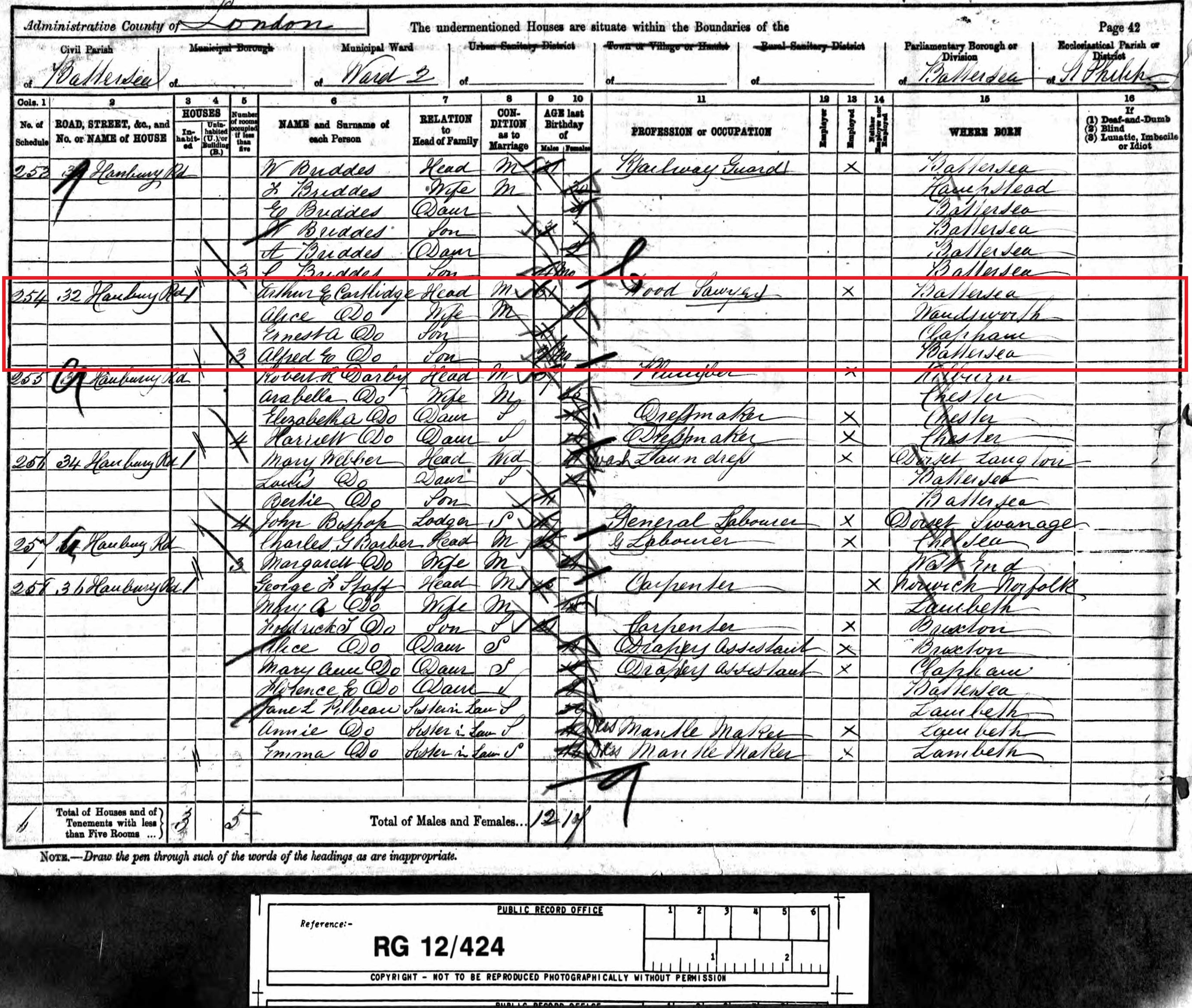
Ernest first appears on a census in 1891, with his parents and younger brother Alfred Edward who was just 2 months old at the time of the census. The family have moved from Wandsworth Road to Hanbury Road.

1891 UK Census

1891 England Census

In 1901 he is still at home with his parents and brother, but have been joined by his 12 year old cousin, Ethel Maud Fisher (the daughter of one of Alice’s brothers). The family has moved again, this time to Mallinson Road – between Clapham Common and Wandsworth Common.

1901 UK Census

1901 England Census

Whilst searching for records, I decided to search the Discovery catalogue of the National Archives – and I’m very glad that I did! I discovered that Ernest had served in the military – something my other half knew nothing about! After a small payment of £3.30, I was able to download his service history.

On 18 November 1903, 15 year old Ernest joined the Royal Navy as a Boy Seaman, and was sent to the training ship HMS Boscowen (originally the 1841 Caledonia class 120-gun ship of the line HMS Trafalgar) for his initial training. By November 1904 he had moved to the HMS Hercules, an ironclad that was launched in 1868. January and February 1905 were spent on the HMS Firequeen, a ‘Special Service Vessel’ that was used as a general depot ship at Portsmouth for several years, and was also a tender for HMS Victory.

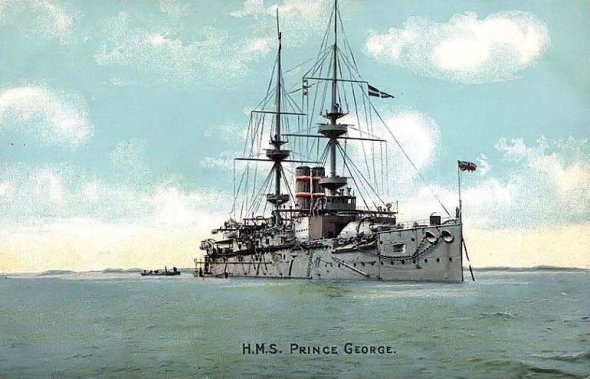
Following this, he moved to HMS King Edward VII. The ship was commissioned on 07 February 1905 and Ernest started his service on her only a couple of weeks later on 22 February. Two months later he was moved to the HMS Prince George (after being “recovered from desertion”), and probably served as part of the Atlantic Fleet. He served on board until October 1906 – although the last two weeks of September were spent in cells.

HMS Prince George

HMS Prince George

He was transferred to HMS Victory (despite the name, it was more than likely one of the shore establishments that were so named) on 08 December 1906, and served until 20 December. I assume at this point he was sent home for Christmas, and he returns to HMS Victory on 1 February 1907 and stays for one week. However, in the notes of his Royal Navy service record, it states that:

14.02.07 Approve discharge, services no longer required after 42 days <unreadable> for breaking out of barracks.

Despite his time in the cells, and his two incidents of desertion, his character is given as “Very Good” or “Good” for most of his naval career.

ernest


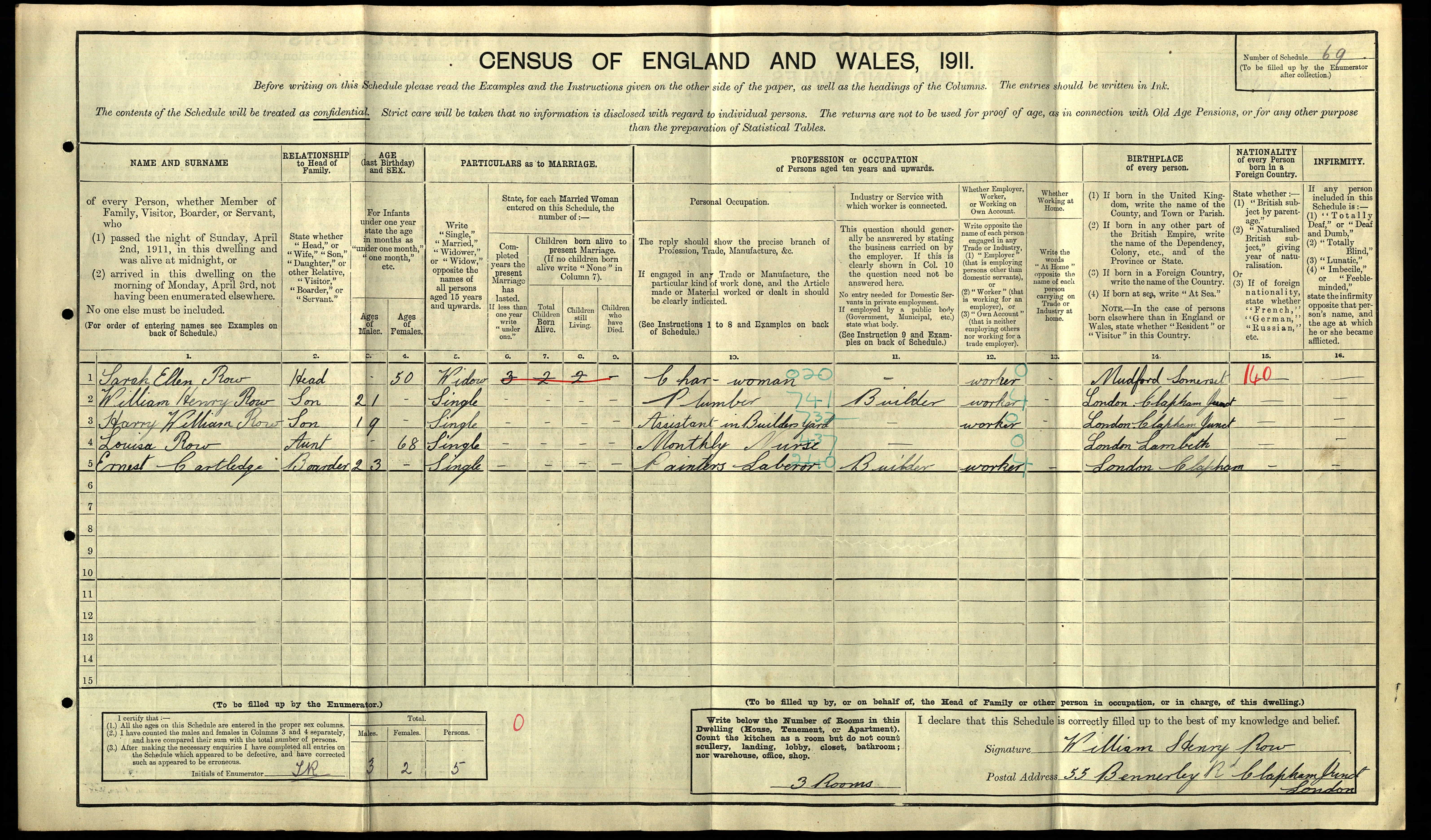
In the 1911 census Ernest is found one road south of his previous address, living on Bennerley Road with the Row family, and is listed as a painter’s labourer. The other two young men in the household are also employed in the building industry (a plumber and a builder’s yard assistant) so it is conceivable that they worked for the same employer.

1911 England census

It is also – presumably – through this family that Ernest met his future wife, Edith. The head of the household in 1911 was a widow, Sarah. She had been married to William Row. He passed away in 1890 aged just 26. His elder sister, Elizabeth, had married William George Winterbourne and had 2 children – George Henry in 1885 and Edith Annie in 1887. In fact, in 1911 they lived in the same building – 55 Bennerley Road. The two of them married on 8th July 1911 in St Michael’s church, Battersea.

31280_198490-00458

Ernest’s father’s occupation here is given as Verger, and on the 1911 census he is enumerated as “Verger and Caretaker”. Given the proximity of Arthur’s street address (Darley Road, Wandsworth Common) to St Michael’s, it would be sensible to assume that this was the church in which he served as verger.

Ernest appears in the 1920 Electoral Register, still living at 55 Bennerley Road. Edith is also listed as present, as are William Row and his mother Sarah, and two members of the Winterbourne family – Elizabeth and William Henry.

Ernest passed away in 1921, aged 32 years. It doesn’t appear that he left a will as he doesn’t appear in the National Probate Calendar. Edith went on to marry a Harry Thomas Wright in 1934, a widower with 5 adult children.

But what of the mysterious outfit?

So far evidence is evasive. However, family lore has him pegged as a ‘singer’. I can’t find any play or musical entitled ‘By The Way’ (apart from the recent one!) so for now great-grandfather Ernest and his amazing eyebrows will remain somewhat of a mystery …

Gateway Ancestors

Alex’s Root to Tip post that I shared a few days ago (what do you mean you missed it? The original is here…) has had me thinking about gateway ancestors.

A ‘gateway ancestor’ is one that links your family to one that is ennobled in some way – landed gentry, some level of aristocracy or – gasp – royalty itself. One perks of finding one of these links (or so you may think) is that these families will have been investigated and documented and pedigree’d many times in the past thus saving you effort and money. Obviously another perk is the added … cachet of having a ‘royal connection’. You can see how this fits in with Alex’s article on mistakes caused by ‘wishful thinking’ – if you had a choice would you prefer to be descended from Boleyn the fish gutter of Stockport or that other Boleyn family of some repute?

Continue reading

Research Updates

Just a little update on a couple of ongoing pieces of research.

The first from Missouri, as first mentioned here. After my 3 or 4 week wait I received a response from the good people at the Missouri State Archives. Unfortunately it wasn’t great news:

We have searched Lawrence County Probate Record Reels C3794, C3781, C3791, C3788, C3790 for records on an adoption of an Adams and Jacob and George.  Nothing was found for an Adams during this time frame.

However, they did find a couple of references to other Adams’ and suggested I contact the Lawrence County Probate Court directly. Which I have done (after a bit of jiggery-pokery – what is it with American offices and incorrectly listed email addresses??), and received a response from the Circuit Clerk who is going to look into the references provided. More on that if / when I get a response.

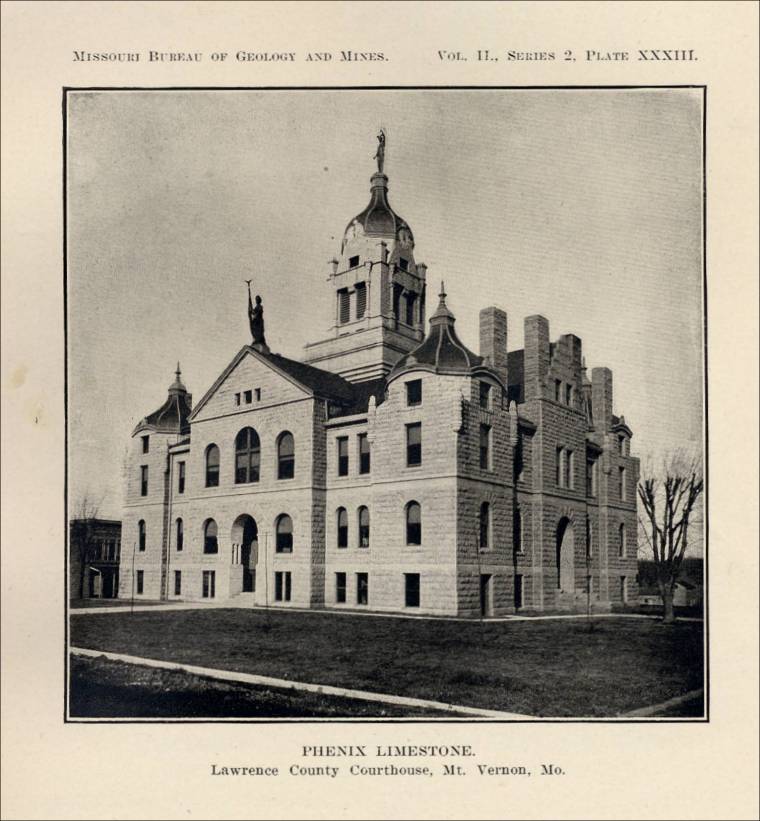
Lawrence County Courthouse (from Missouri Marble, by Norman S. Hinchey)

Lawrence County Courthouse (from Missouri Marble, by Norman S. Hinchey)

Secondly, the Frenchies. You know, the postcard people.

My study of the online records continues – and I’ll admit to being somewhat obsessed by it. I think, possibly, its because its something new to me. I am no stranger to the fluidity of surname spelling, but it does fascinate me seeing how the French spellings change. For example, one branch of the family is Clergeau, but going back only a few generations it becomes Clairjault. Virtually the same pronunciation, yet quite different (and before you ask – yes, the same family!). It happens with others. Baranger becomes Barangé, Doublié becomes Doublet, Massé becomes Massais. Families also seem to move around between parishes more frequently than I am used to seeing in my own English researches. The vast majority are – what we’d call in the UK – Agricultural Labourers. Perhaps the reason for this difference is the way the French system is structured – communes, cantons, prefectures.

I was talking to my ‘cousin’ the other night online (he lives in Connecticut) and he asked if I was going to try and find any descendants of these people still living and make contact. It got me to thinking. Initially I said that I wouldn’t because there’s a bit of a gap between the years available online and the present day. Admittedly, Amelie only died in 1972 – but Louise would’ve been 102 this gone January.  The fact that all of these photographs and postcards were being sold at a marché aux puces suggests that there is no longer anybody around who cares for these people.

Whilst it would be nice to connect with this family, somehow I don’t think its going to happen. In the mean time, this is how the ancestral tree for Louise is looking.

Vertical Pedigree Chart for Louise Baranger

Not too shabby. Still a lot of deaths to fill in (like some kind of assassins day-planner), but I’m getting there!

The tree is also on Ancestry. I wanted to publish and publicize it a bit on the off-chance that somebody at some point decides to search for their family and gets in touch!

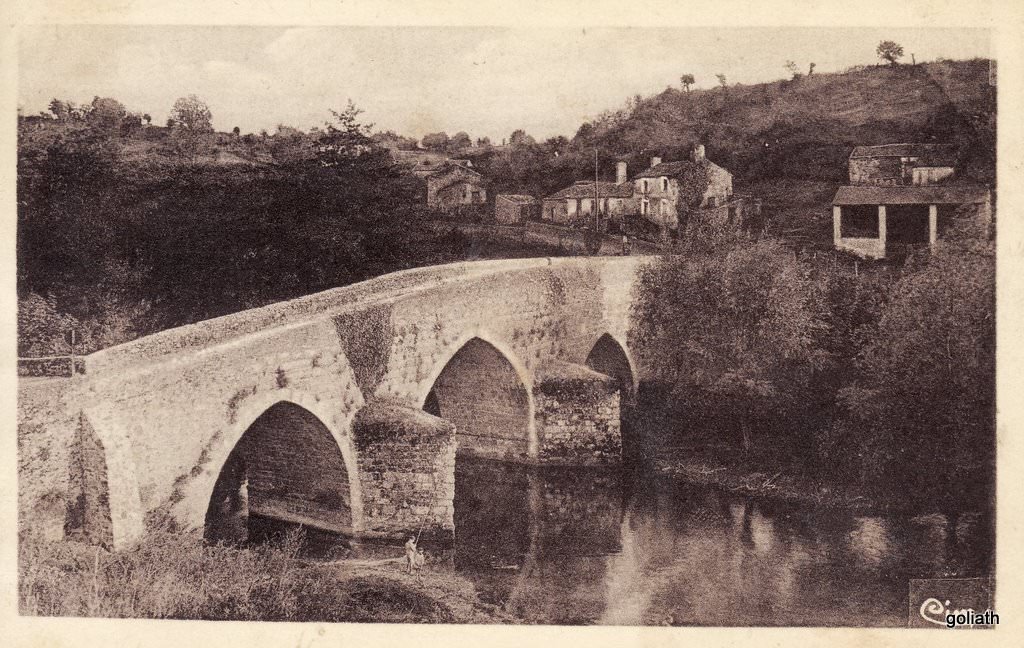
 L'antique Pont-Neuf,  Argenton-Château

L’antique Pont-Neuf, Argenton-Château

Names, Names, Names

As a genealogist and an author a writer, names fascinate me. Consequently, when I saw this week’s Weekly Writing Challenge published by The Daily Post it ticked all kinds of boxes. I often look at the Daily Prompt and the Weekly Writing Challenges, but rarely do I take part (for the Daily Prompts its usually because I’m a day or so late). In a nutshell, the challenge is to consider the power of names and to look at my own history with my name.

As a child, growing up in the 1980s I never met anybody else with my name. Whilst perhaps not considered ‘exotic’ by many, I longed for a normal name. Toby would’ve been my first choice. I would’ve been happy with Steve. Ian would’ve been fine. (To put this into perspective I also thought that I was an android and/or adopted for a large part of my pre-adolescent life.) All of my brothers have ‘regular’ names. I had no idea why I had been singled out, so I asked my mother why she/they had chosen the names they did for the four of us.

She told me that she wanted to choose names that paired well with our Scottish-sounding surname (there was an assumption, based on the surname alone, that my father’s family were from Scotland, but research by me seems to suggest otherwise – in fact you can’t get much further away from Scotland than Dorset and still be on the same landmass). There wasn’t much thought given to the meaning of those names, but definitely to the way that the three names (we all have first an middle names) sounded together.

In turn, my brothers’ names mean ‘House-guard Unknown-Etruscan-word’, ‘Healer Stone’ and ‘Defending-men Of-Brix [a town in France]’. Technically my name means ‘Of-the-Lord Rich-guard’. I wasn’t born on a Sunday and my parents aren’t particularly religious. Clearly my first name was chosen purely for the sound and not the meaning. My middle name, however, was the name of my father’s stepfather who was gravely ill in hospital at the time of my birth (indeed, he passed away shortly after ‘meeting’ me), something I’m proud of (the naming for a family member part, not my face causing the death of an old man part).

As I’ve grown older I’ve pretty much made peace with my name. Its still fairly uncommon. I’ve only met or heard of a handful of people with the same name, and slept with some of them (as a side point – sleeping with someone who has the same name as you is a little weird, but not as weird as sleeping with someone who has the same name as a sibling or a parent). The Wikipedia list of notable people with my name is fairly short but is widespread across the worlds of media, politics, military, sports, the arts and the sciences.

As I say, I’m okay with it now. Its different enough to cause me to stand out and although I have suffered ridicule because of it (teenage boys – go figure), I am not ashamed of it. Which is good enough for me.

When I write and need to create a new character the choosing of a name is something I take very seriously. All of us carry particular prejudices and opinions about names. (Recently, I read an article regarding a number of people in the Middle East who were named Saddam Hussein after the Iraqi leader and who have subsequently found it a very difficult burden to shoulder.) But apart from that, I do like to investigate the meanings of the names I’m using. Luckily, in this age of the internet, I don’t have to have a name dictionary (although I do have one regarding surnames). My favourite site for this is Behind The Name.

During my years as a genealogist the reusing of certain names has become very apparent . The pool of names used for children varies dependant on national and local fashions of the time, religious beliefs, the level of education and also other familial names. The mother’s maiden name often becomes the middle name of one or more of the children. The name of a wealthy uncle could be passed on, in the hope of money following the same path.

There is an almost standard pattern for the naming of children:

  • The first son was named after the father’s father
  • The second son after the mother’s father
  • The third son after the father
  • The fourth son after the father’s eldest brother
  • The first daughter after the mother’s mother
  • The second daughter after the father’s mother
  • The third daughter after the mother
  • The fourth daughter after the mother’s eldest sister

Obviously not all families followed this, and some children could be named out of the pattern due to the death of a family member or perhaps a famous event, or the death of an older child leading to the same name being ‘recycled’ for a younger sibling.

Whatever the reason, the name a child carries generally says more about the parents than the child. At the end of the day. as W. C. Fields said: “It ain’t what they call you, it’s what you answer to.”