This shouldn’t be a long post, but I think that I may have blasted through the research quagmire of my Hallidays in Sherston that I mentioned last time. (Soon it’ll be back to business, i.e. more Holborows, more Murrays, some asylum records …)
As I said, I think that I may have cracked the wall I’d come up against. It isn’t a perfect fit, and nobody look at the evidence with a magnifying glass, but it fits nonetheless.
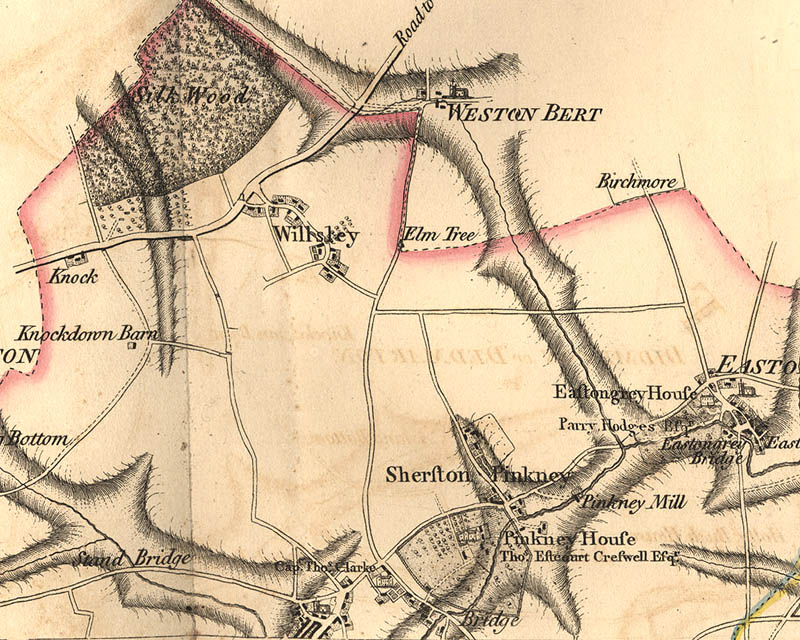
Of course you remember that I had got back to my 8 x great-grandfather, John Halliday and his wife, Mary, baptizing their children in the parish of Sherston, Wiltshire, In all likelihood they lived in the small hamlet of Willsley. On the map below what is labelled Silk Wood is now part of Westonbirt Arboretum. The pink line denotes the county border between Wiltshire and Gloucestershire, and the village of Sherston Magna (aka Great Sherston) is off to the bottom left, not shown. Sherston Pinkney is shown on the map, aka Pinkney aka Sherston Parva aka Little Sherston …
John and Mary likely both died in 1729. I can’t find a marriage in either Wiltshire or Gloucestershire for them, and I suspect I may be missing something somewhere. Keeping within Sherston parish registers, there is a John Hollyday baptised there on 5 October 1663 (and the curate has helpfully recorded birth dates, so I know he was born a few weeks prior on 22 September). The parents are listed as Richard and Rebekah. If this was my John then it would make him around 65 years of age when he died. This seems acceptable, but it makes him around 40 at the first baptism of his children in 1702. Are there more children elsewhere with Mary, or maybe there’s a first wife? There are no unaccounted-for female Halliday burials in Sherston, but that might just mean they lived somewhere else (i.e. in Gloucestershire) and she is buried in that location. Or he might just have married late. Not impossible. So a question mark there.
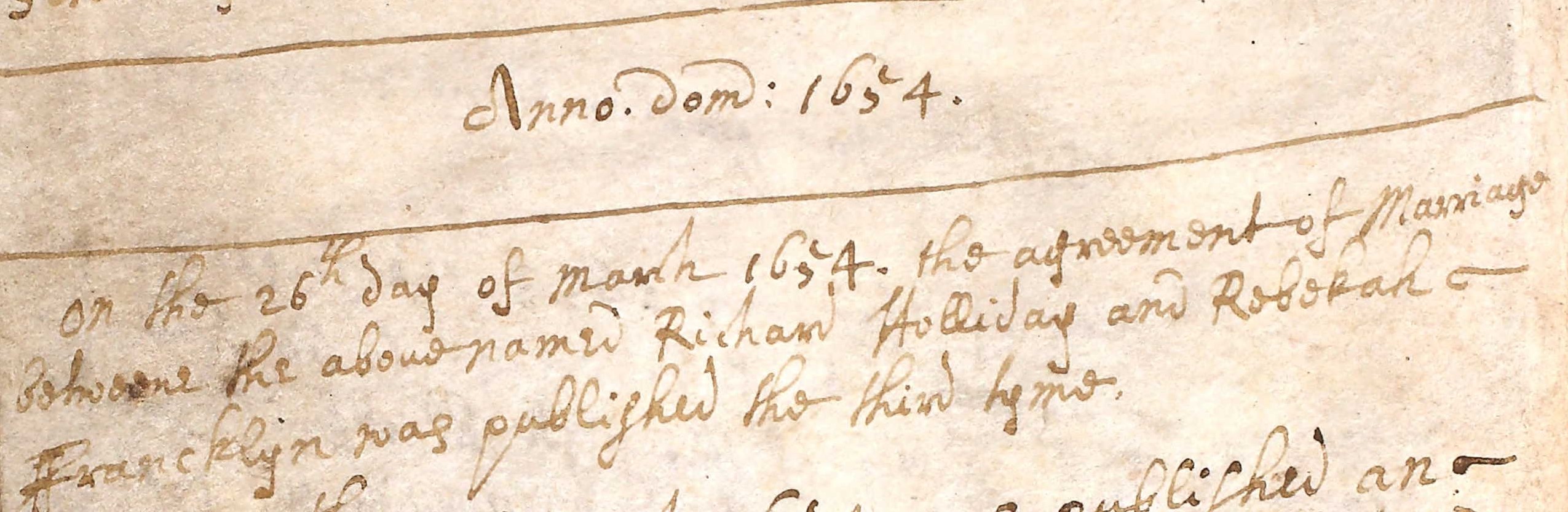
There are just three other children baptised to Richard and Rebekah in Sherston – Emma in 1654, Samuel in 1665, and William in 1666. Given the 9-year age gap between Emma and John it seems likely there are more children elsewhere. Not that I can find them being baptised or buried anywhere nearby or even over the border in Gloucestershire! Richard and Rebekah married in Sherston on 13 April 1654. Rebekah is noted as being the daughter of Richard Francklyn, and Richard as being “a clothier, of Horsley, Glos.” Also recorded is Richard’s father, Samuel, as one of the witnesses. Which is only recorded in full on the original document (i.e. the transcriptions at Ancestry and FMP do not include this information!). Need I say anything about checking the original? Apparently, I did.

Phillimore’s Wiltshire Marriage Index (the Phillimore Marriage Registers were created by William Phillimore Watts Stiff and are printed parish marriage registers for over a thousand parishes) holds some additional information:
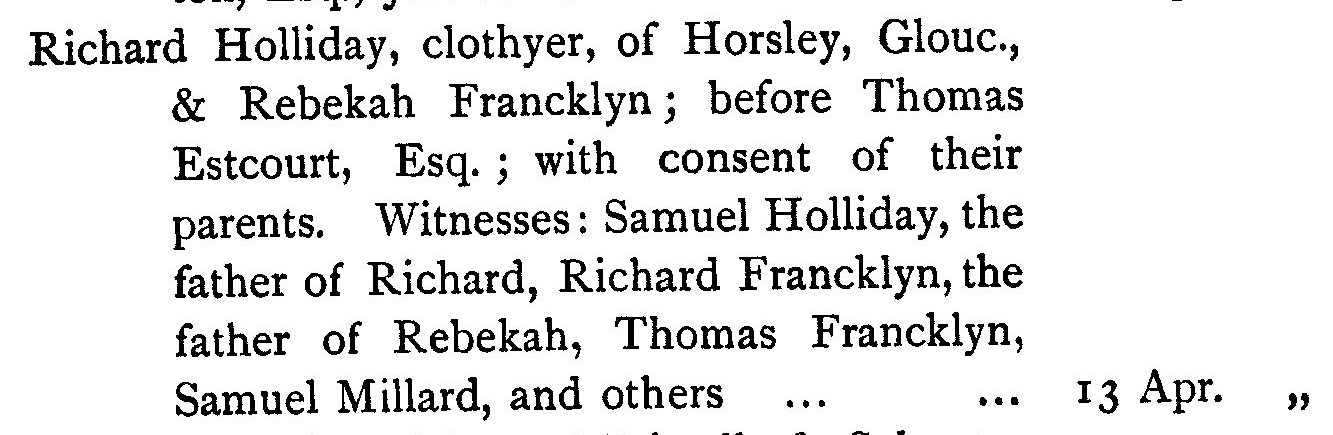
Richard was a clothier and of Horsley, Gloucestershire (i.e. he lived in Horsley and not in Sherston). We also know that they were both likely to be under the age of 21, given that the notice states that the marriage took place “with consent of their parents”. The fact they were married by a Justice of the Peace isn’t as strange as you might at first think. Their marriage took place almost smack in the middle of England’s Commonwealth period. Oliver Cromwell and all that Puritan goodness (if ever there was a War on Christmas, these guys were definitely the ones to do it). One of the parliaments (known as the Nominated Assembly or ‘Barebone’s Parliament’) managed to reform some of the laws and the conducting of marriages was taken away from the clergy altogether and vested in justices of the peace. Parishes were to elect a registrar to keep records of the new unions. Whereas in earlier forms the age of consent was vague, ‘years of discretion’, in the 1653 formula it was set at 16 for men and 14 for women, with parents needing to give consent for the under-21s. The Restoration of the Monarchy in 1660 reinstated the requirement for all marriages to take place in front of a priest (i.e. in a church).
It would be hecking convenient to attach Richard (of Horsley) to the Minchinhampton Hallidays – not only is Horsley a mere 3 miles down the road, but I could then re-attach this line to the line that stretches back to Walter the Minstrel. However, I don’t think this is the case – or at least it is not provably the case, although I suspect that there is a link somewhere. There is a Richard, son of Samuel, baptised in Stonehouse in 1629 – although he wouldn’t have needed to marry with parental consent in 1654. (For reference, Stonehouse is only about 7 miles from Horsley.)

However, if this is the right Richard, then examining the Parish Registers for Stonehouse and the nearby parish of Leonard Stanley gives me a further 7 potential siblings for Richard, running from 1609 to 1640. There is also a Will and Inventory for a Samuel Holliday of Horsley in 1663. In it, he leaves various bequests to his sons Richard and Samuel and his daughters Mary Board (named as wife of Henry Board) and Anna Holliday. He also mentions a grandchild, Samuel Holliday, the son of Samuel, and another Samuel, the son of John. There is no wife – named or otherwise – included which makes me think that he was a widower by the time he died. (Although this isn’t necessarily the case!)
I suspect this Samuel is one and the same as the father named in Richard’s marriage document as I can find baptisms for the children Samuel, Richard, John and Anna mentioned therein. I can find a later will of 1775 for a Samuel Halliday of Bisley, Gloucestershire. (Note: Bisley is approximately 8.5 miles from Horsley.) In it, he names three sons by his first wife (Samuel, William, James) and two by his second – and current [unnamed] – wife (John and Richard). There is also a possible daughter, Elizabeth, who is mentioned only as the mother of Daniel Tyler who receives a few items – possibly as a grandchild? Could this Samuel be descended from one of the grandsons named Samuel in the previous will? It seems unlikely that a child would be alive to be named in 1663 and 1775! But the repetition of the name Samuel seems key, as does the inclusion of the name Richard. (Of course, Richard could feature in the second wife’s family.)
There are a number of Halliday/Holliday wills from around Stroud, none of which seem to clearly match into family groups that mesh with mine (or at least I’m not intending to wade through disparate entries at this point to see what trees can be built out of the information). However, there are very few of the group living in Sherston that appear in the probate record (one of those being my 8 x great-grandfather, John – or more precisely his son, Thomas, being granted administration of the estate in 1729 as John died intestate

So whilst I’m not out of the Halliday woods quite yet – there is a veritable tangled thicket of them in that area of Gloucestershire which is an entire project in and of itself, especially as mother’s names don’t seem to have been recorded in the parish registers! – I am happier having reviewed the information I had been given, making sense of it, and removing the incorrect links. It was a bit of a bum job, but definitely worth it.
 The Family Mess