This is really a continuation of my last post, Grandfathers & Other Animals. I wanted to share my explorations into the lives of my two American grandfathers – Ellis Howard Adams and Robert Leslie Payne – and this is the entry for my mother’s father, Ellis.
Whilst my great-grandmother was alive, with her dandelion-fuzz hair and easy smile, she once sat my mother down with a photo album. After she died, the album made it to our house, and was kept in the dresser with the rest of the family papers, birth certificates, locks of hair and the rest. On a few occasions my mum would get this album out and we’d sit down with a mug of tea and she’d tell me about the people captured within.
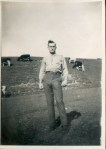
There on page 9, unremarked and unremarkable, was a picture of a man in a cow field. Dressed in a military uniform of some description, handsome in his own way, quiffed hair blowing in an invisible breeze, tie tucked into his shirt between two buttons. My mother recounted the story of how on one occasion her grandmother had tapped the photo with a finger and said “That’s your dad.”

Ellis Howard Adams
Other than his name, a picture (which remains the only photo I have of him to this day), and that he served in the American Army during WWII, nothing of detail was known about him.
Two of the main proponents of genealogical research are to work backwards and work with what you know to be true. The first thing that we knew to be true was that Ellis and my grandmother Eva had been married, so I set about searching for their marriage certificate. Whilst a copy of that certificate – and any subsequent divorce papers – may have originally been amongst my grandmother’s papers, upon her death they were … removed from her house. Using the General Register Office website, I ordered a copy of their certificate.
Once it arrived I had a few more details.
They had married on 23 November 1944 in The Register Office, Devizes in front of two witnesses – Eva’s parents. Ellis’ details stated that he was 20 (putting his birth at around 1924) and the divorced husband of Pauline Adams formerly Harper, spinster. It also stated he was a Private First Class in the American Army, gave his Army number and also his employer outside of Army life – Checkers Building Company – and that although currently residing at the barracks at Roundway (near Devizes), he was a resident of Sarcoxie, Missouri. He also stated that his father was named Joseph and that he was a farmer, but deceased.
Now that I knew a few important facts, I thought that I would try to locate his Army service record. After some online research, I printed, filled out and posted off a form for the National Personnel Records Center in St. Louis. The response that came back in a couple of months was … not exactly what I was hoping for. Unfortunately, in July 1973 a fire in the NPRC destroyed a portion of the records held there. Ellis’ full military record was one of those destroyed. However, they were able to send me a copy of his Report of Separation. This shed a few more interesting facts about him.
- Private First Class, Infrantry, Rifleman 745
- Date of separation: 12 May 1945, Brigham City, Utah
- Date of induction: 9 March 1943. Date of entry into active service: 16 March 1943, Fort Leevenworth, Kansas
- Service outside of the USA: 14 May 1944 – 26 March 1945, European Theater of Operations
- Foreign Service 10 months, 12 days
- Continental Service 1 year, 3 months, 12 days
- Longevity for pay purposes: 2 years, 1 month, 24 days
- Honourable discharge due to “anxiety hysteria”
- Fought in the “Normandy and German Campaign”
- Wounded in Battle 27 July 1944
- Awarded Purple Heart, two Bronze Campaign Stars, European-African Middle Eastern Theatre Ribbon
-

- Purple Heart
-

- EAME Ribbon
-
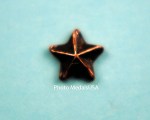
- Bronze Star
So what does this limited information tell us? We know Ellis was wounded in action in July 1944, undoubtedly the reason why he was awarded the Purple Heart. The Bronze Stars were awarded for acts of heroism, acts of merit, or meritorious service in a combat zone – but I have no idea what he did on each occasion to receive them. The EAME ribbon (there was no medal attached until 1947) was awarded for military service in the geographical theater areas of Europe, North Africa, or the Middle East and covered a variety of military campaigns. Comparing information from different sources and that on the separation report I can assume that he was involved in the D-Day landings and possibly also the Battle of the Bulge, the Allied advance from Paris to the Rhine or the Western Allied invasion of Germany. However, without knowing his exact regiment its impossible to say for certain – and so far that seems to be unlikely.
“Anxiety hysteria” as far as I can tell is a historical term for a psychological condition which combines an anxiety disorder with a conversion disorder – that is:
… psychologists once believed that physical symptoms manifested as a result of an anxiety disorder. Such disorders were once collectively termed “hysteria.” While it is certainly true that some anxiety disorders can be linked with conversion disorder, these two conditions can also appear independently. Patients diagnosed with anxiety hysteria were typically treated as neurotics, and the mode of treatment selected was not always entirely beneficial, sometimes because the patient suffered from a genuine neurological problem which remained unidentified.
Nowadays one would assume that it would be something along the lines of PTSD – hardly surprising.
The report also gives some other personal information:
- Place of birth Neosho, Missouri
- Date of birth 10 April 1924
- Brown hair, brown eyes, 6’0″, 180lbs
- Occupation: laborer
- 8 years of grammar school
- Address at time of entry into service: 513 Williams Street, Carthage, Missouri
- Permanent address for mailing purposes: 1555 East Main Street, Stockton, California
- Married, with one dependent
Lets look at that last one. Assuming he was telling the truth on his English marriage certificate, the “married, 1 dependent” could well be my grandmother and mother as he was shipped back to America after having been married for 4 months, and 3 months before my mother was born.
A search of the Stockton City Directory for 1945, 1947 & 1949 comes up blank on Ellis. By 1950 he is resident once again in Carthage, Missouri, but has disappeared by 1953. No other obvious marriages can be found, and so far I don’t have a concrete location for his death. The United States Social Security Death Index has an entry for Ellis H Adams, date of birth 10 April 1924 who died 14 August 1971 … but last place of residence is blank. A recent hint seems to suggest somewhere in Virginia, and steps have been taken to investigate that one … I’ll keep you updated!
But that search – which included his Social Security Number – allowed me to request his SSN application (well, via a request in an online forum and a very kind lady).
The details of that confirmed his date and place of birth, including the same address in Carthage. It also listed his parents names: Dollie Clara Falkner and Jacob Calvin Adams (not Joseph as listed in his marriage certificate).
Using that information I was able to locate Ellis in the 1940 and 1930 US Federal Census returns, living with his family in Missouri.
-

- 1930 US Census, Neosho MIssouri
-

- 1940 US Census, Carthage Missouri
I was also able to uncover a marriage license between a Howard Adams and a Pauline Harper in Webb City, Missouri (roughly 10 miles from Carthage).
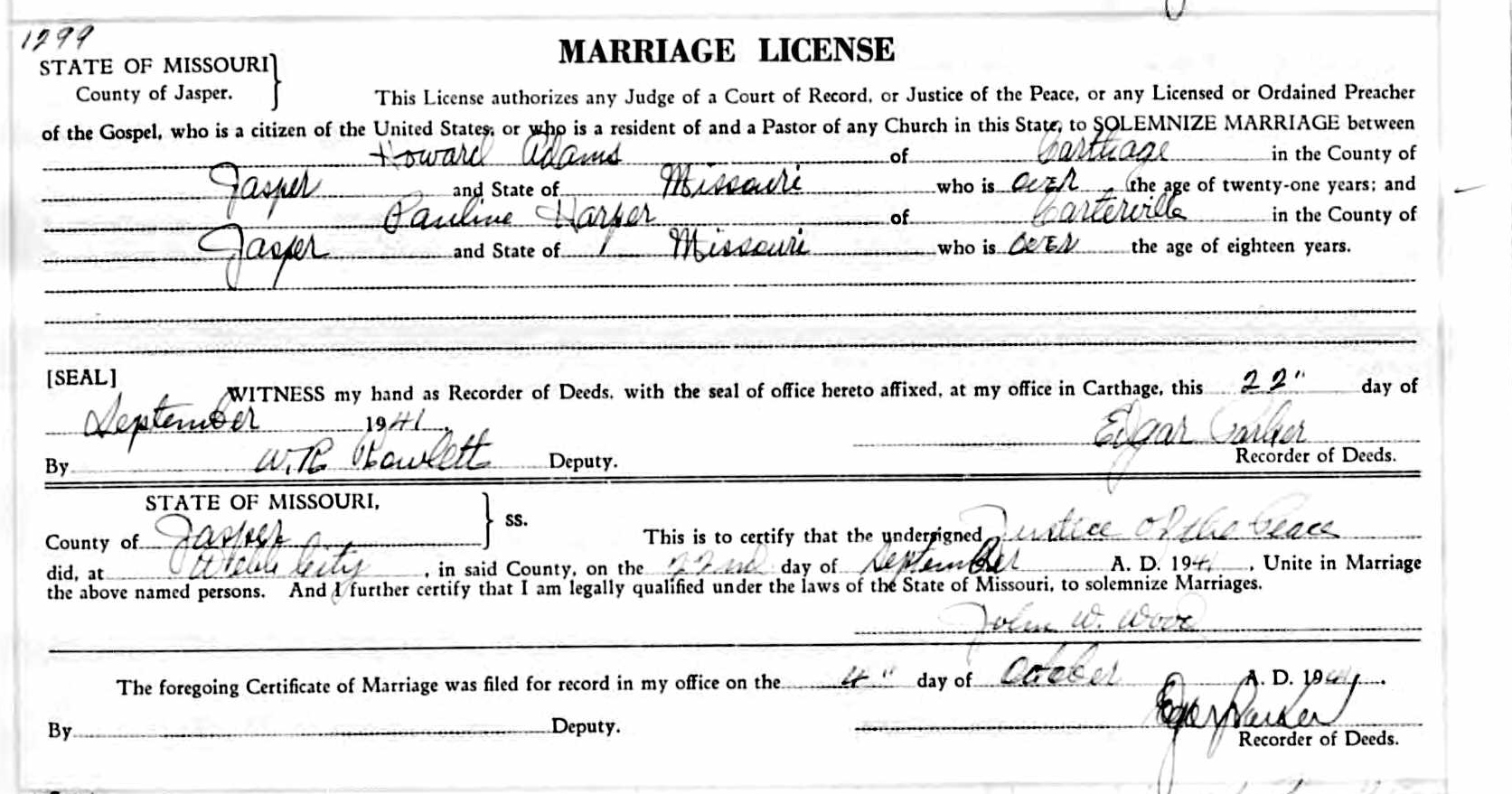
Marriage License – Adams/Harper
So far that’s it for Ellis Howard Adams. Once a death certificate can be found then perhaps new avenues will surface. I have made contact with relatives of Ellis – descendants of siblings – but they all say that the family was fairly fragmented and not close. Nobody knew what had happened to Ellis after the war. Answers remain to be found out there. And more questions too, no doubt …



 The Family Mess